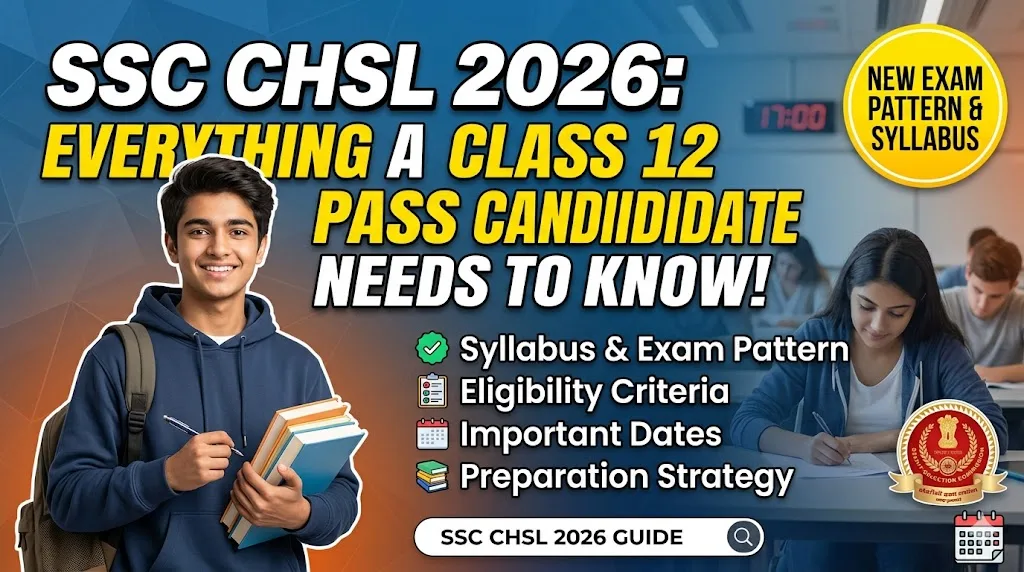
The Staff Selection Commission Combined Higher Secondary Level (SSC CHSL) examination is one of the most accessible central government recruitment exams in India — it requires only Class 12 qualification, making it the entry point for lakhs of aspirants who have not yet completed graduation. The posts recruited through SSC CHSL — Lower Division Clerk (LDC), Junior Secretariat Assistant (JSA), Postal Assistant (PA), Sorting Assistant (SA), and Data Entry Operator (DEO) — are permanent central government positions with job security, pension, and growth potential.
This guide covers the complete SSC CHSL 2026 syllabus, exam pattern, eligibility, and preparation strategy.
SSC CHSL 2026 — Overview
| Detail | Information |
|---|---|
| Conducting Body | Staff Selection Commission (SSC) |
| Full Form | Combined Higher Secondary Level |
| Posts | LDC, JSA, PA, SA, DEO |
| Qualification | Class 12 pass from any recognised board |
| Age Limit | 18–27 years (varies by post) |
| Exam Mode | Computer Based Test (CBT) |
| Official Website | ssc.nic.in |
Posts and Pay Scale
| Post | Department | Pay Level |
|---|---|---|
| Lower Division Clerk (LDC) | Various central govt offices | Level 2 (₹19,900–₹63,200) |
| Junior Secretariat Assistant (JSA) | Parliament Secretariat | Level 2 |
| Postal Assistant (PA) | Department of Posts | Level 4 (₹25,500–₹81,100) |
| Sorting Assistant (SA) | Department of Posts | Level 4 |
| Data Entry Operator (DEO) | Various departments | Level 4–5 |
| DEO Grade A | Office of CAG | Level 4 |
SSC CHSL 2026 Exam Pattern
SSC CHSL has two tiers:
Tier 1 — Computer Based Examination
| Subject | Questions | Marks | Time |
|---|---|---|---|
| General Intelligence & Reasoning | 25 | 50 | |
| General Awareness | 25 | 50 | |
| Quantitative Aptitude (Basic Arithmetic) | 25 | 50 | |
| English Language (Basic Knowledge) | 25 | 50 | |
| Total | 100 | 200 | 60 minutes |
- Negative marking: 0.50 marks per wrong answer
- Qualifying in nature for some posts — Tier 1 marks count in final merit for most posts
Tier 2 — Descriptive Paper
| Component | Details |
|---|---|
| Essay | 200–250 words on a given topic |
| Letter/Application | Formal or informal |
| Total Marks | 100 |
| Duration | 60 minutes |
| Mode | Pen and paper |
| Medium | English or Hindi |
| Qualifying marks | 33% (General), 33% (all categories) |
Skill Test / Typing Test
Required for specific posts after Tier 2:
- DEO: Data Entry Speed of 8,000 Key Depressions per hour
- PA/SA: Typing speed of 35 words per minute in English or 30 words per minute in Hindi
- LDC/JSA: Typing speed of 35 WPM (English) or 30 WPM (Hindi)
The skill test is qualifying — it does not add marks to your final score.
Complete Syllabus
General Intelligence & Reasoning
- Semantic analogy and classification
- Symbolic operations and number analogy
- Trends and figural analogy
- Space orientation and visualisation
- Venn diagrams
- Drawing inferences
- Punched hole/pattern folding and unfolding
- Figural pattern folding and completion
- Indexing and address matching
- Date and city matching
- Classification of centre codes/roll numbers
- Small and capital letters/number coding, decoding, and classification
- Critical thinking
- Problem solving
- Emotional and social intelligence
- Word building and coding/decoding
General Awareness
- Current events — national and international
- India and its neighbouring countries — history, culture, geography, economic scene, general polity, Indian Constitution, scientific research
- History — ancient, medieval, modern India
- Geography — physical, social, economic
- Indian polity — Constitution, parliament, state legislatures
- Science — Physics, Chemistry, Biology at Class 10 level
- Economy — Indian economy basics, budget, five-year plans
- Sports, awards, books and authors
Quantitative Aptitude (Basic Arithmetic Skill)
- Number systems and computation of whole numbers
- Decimals and fractions — relationship between numbers
- Fundamental arithmetical operations
- Percentages
- Ratio and proportion
- Square roots and averages
- Interest — simple and compound
- Profit and loss, discount
- Partnership
- Mixture and alligation
- Time and distance, time and work
- Basic algebra and geometry
- Regular polygons, right prism, right circular cone, cylinder
- Sphere, hemispheres, rectangular parallelepiped
- Regular right pyramid with triangular or square base
- Trigonometric ratios and degree and radian measure
- Standard identities
- Complementary angles
- Heights and distances
- Histogram, frequency polygon, bar diagram, pie chart
English Language (Basic Knowledge)
- Spot the error
- Fill in the blanks
- Synonyms and antonyms
- Spelling/detecting misspelled words
- Idioms and phrases
- One-word substitution
- Improvement of sentences
- Active/passive voice
- Direct/indirect narration
- Shuffling of sentence parts
- Shuffling of sentences in a passage
- Cloze passage
- Comprehension passage
Eligibility
Educational Qualification: Class 12 pass (or equivalent) from any recognised board. No graduation required — this is the key differentiator from SSC CGL.
Age Limit:
| Post | Age Limit (General) |
|---|---|
| LDC / JSA | 18–27 years |
| PA / SA | 18–27 years |
| DEO | 18–27 years |
| DEO (CAG) | 18–27 years |
Age Relaxation:
| Category | Relaxation |
|---|---|
| OBC | 3 years |
| SC/ST | 5 years |
| PwD (General) | 10 years |
| Ex-Servicemen | As per rules |
Preparation Strategy
Tier 1 Strategy
SSC CHSL Tier 1 is similar to SSC CGL Tier 1 — same subjects, same structure, slightly lower difficulty level. If you are preparing for both exams, your SSC CGL Tier 1 preparation covers CHSL Tier 1 completely.
Reasoning (50 marks): Figural reasoning and visual/spatial questions feature more prominently in CHSL than in CGL. Practice paper folding, embedded figures, and mirror images specifically — these appear regularly in CHSL papers but less in CGL.
Quantitative Aptitude (50 marks): The level is Class 10 — simpler than CGL. Percentages, profit and loss, and time and work are the highest-frequency topics. Focus on speed — you have less than 40 seconds per question in a 60-minute paper.
English (50 marks): Error spotting, fill in the blanks, and synonyms/antonyms are the most common question types. One-word substitution and idioms/phrases appear regularly. Read an English newspaper daily for 30 minutes — this covers vocabulary, grammar awareness, and comprehension together.
General Awareness (50 marks): Static GK (history, geography, polity, science) makes up approximately 60–70% of this section. Current affairs from the last 4–5 months makes up the remaining 30–40%. Use Lucent’s GK for static content and one monthly current affairs digest.
Tier 2 Strategy
Essay writing: Practice writing 200–250 word essays on topics related to current affairs, social issues, and general topics. The key is structure — introduction, body (2–3 paragraphs), conclusion — and staying within the word limit. Practice one essay per week for 2 months before Tier 2.
Letter/Application writing: Practice formal letter writing (complaint letters, job applications, official correspondence) and informal letter writing (to friends, relatives). Format and appropriate language are more important than length.
Medium choice: Choose the medium (English or Hindi) you are more comfortable writing in. The Tier 2 paper is descriptive — writing quality matters, not just content.
Typing Test Preparation
If targeting PA/SA or LDC posts, start typing practice from the beginning of your preparation — not after clearing Tier 2. Reaching 35 WPM in English takes consistent daily practice over 2–3 months for most candidates starting from scratch. Use free online typing practice platforms like Typing.com or KeyBr.
SSC CHSL vs SSC CGL — Which to Prioritise
| Factor | CHSL | CGL |
|---|---|---|
| Qualification needed | Class 12 | Graduation |
| Difficulty | Moderate | Higher |
| Pay scale | Level 2–5 | Level 4–8 |
| Post quality | Good entry-level | Better posts |
| Competition | High | Very High |
Honest advice: If you have completed graduation, appear for both CHSL and CGL simultaneously — the syllabus overlap is significant. CHSL is a good safety net while you build toward CGL. If you have only Class 12, CHSL is your primary target — focus on it fully.
Official Links
- SSC Official Website: ssc.nic.in
- Previous Year Papers: Available on ssc.nic.in under Previous Question Papers section
Published by ExamzPrep — free government exam preparation for serious aspirants. Last updated May 2026.

Zahid Bhat is the founder of ExamzPrep. He has spent the last 4 years following JKSSB, SSC, Banking, Railway, UPSC, and State PSC recruitment cycles closely — tracking syllabus changes, question paper trends, and notification updates — and has qualified a JKSSB examination himself. ExamzPrep is built on that firsthand preparation experience: honest, free content for self-studying aspirants, with no courses to sell and no coaching to promote.