
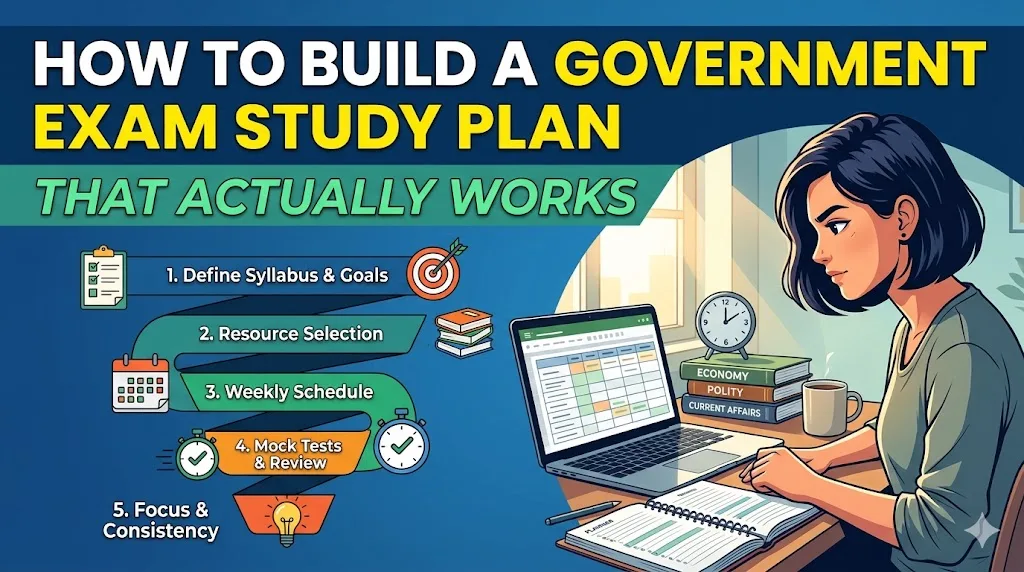
Most government exam aspirants do not fail because they lack intelligence or dedication. They fail because they study without a plan — reading books randomly, solving questions without tracking accuracy, and spending time on topics proportional to how much they enjoy them rather than how many marks they carry.
A study plan is not a timetable you draw on Sunday and ignore by Tuesday. It is a structured approach to preparation that makes your study time count — covering the right topics in the right order, identifying and fixing weaknesses systematically, and building toward exam-day performance rather than just accumulating hours.
This guide shows you how to build one from scratch.
Step 1 — Know Your Exam Before Touching Any Book
Before opening a single textbook, spend one full day understanding your target exam completely.
What to find out:
- Exact syllabus — download the official PDF from the conducting body’s website
- Marks distribution — which subject carries how many marks
- Exam pattern — number of stages, MCQ or descriptive, time limits
- Negative marking — how much per wrong answer
- Previous year papers — what topics actually appeared and how frequently
- Cut-off marks — what score has been needed to clear in previous years
Why this matters: A candidate who starts studying without knowing the marks distribution will inevitably spend time on low-mark topics and under-prepare high-mark ones. This is the most common and most costly preparation mistake.
The output of Step 1: A prioritised topic list — every topic in your syllabus ranked by marks contribution. This list, not a textbook’s table of contents, drives everything that follows.
Step 2 — Assess Your Starting Level
Before planning forward, know where you currently stand.
How to assess: Take one full-length previous year paper under timed conditions — no phone, no breaks, strict time limit. Score it honestly. Calculate your accuracy in each subject.
What to look for:
- Which subjects are you already scoring well in? (60%+ accuracy)
- Which subjects are weak? (below 40% accuracy)
- Which subjects are in between? (40–60%)
The output of Step 2: A clear picture of your strengths and weaknesses. This prevents two common mistakes — spending excessive time on topics you already know well, and ignoring topics where you have the most room to improve.
Step 3 — Set Realistic Timelines
Government exam preparation has three phases. Map your available time to each.
Phase 1 — Foundation (covering all syllabus topics)
This is the reading and understanding phase. Go through every topic in your syllabus systematically, building baseline knowledge. Do not try to master everything — build familiarity with all topics before going deep on any.
Duration: 40–50% of total preparation time.
What to do: Read standard books topic by topic. Make brief notes — not exhaustive notes, just key facts and concepts that you will revise later. Do not solve mock tests yet.
Phase 2 — Practice (building accuracy and speed)
This is the most important phase. Move from understanding to application — solving questions under timed conditions, tracking accuracy, and identifying specific weaknesses within topics.
Duration: 35–40% of total preparation time.
What to do:
- Solve previous year papers topic by topic, not full papers yet
- Track accuracy by topic (see below)
- Identify specific sub-topics where your accuracy is below 70%
- Go back to your notes and books for those specific sub-topics
- Return to practice — the cycle repeats
Phase 3 — Refinement and Mock Tests
The final phase — full-length timed mock tests, analysis, and targeted revision of remaining weak areas.
Duration: 15–20% of total preparation time.
What to do:
- 2–3 full mock tests per week
- After every mock: detailed analysis (not just score, but topic-wise accuracy)
- Target remaining weak areas specifically
- Final revision of notes — not new content
Step 4 — Build the Daily Schedule
A realistic daily schedule for someone studying alongside other responsibilities (job, college, family):
3-Hour Daily Schedule
| Time Block | Subject | Duration | Activity |
|---|---|---|---|
| Block 1 (fresh mind) | High-marks subject | 60 minutes | New content or practice |
| Block 2 | Second priority subject | 45 minutes | New content or practice |
| Block 3 | Rotating subjects | 45 minutes | Weaker areas |
| Block 4 | Current affairs | 30 minutes | Newspaper reading or current affairs digest |
Rotating subjects: Cycle through lower-priority subjects (Computer Knowledge, General Science, English) so each gets attention weekly without dominating your schedule.
5-Hour Daily Schedule (dedicated preparation)
| Time Block | Subject | Duration |
|---|---|---|
| Morning (fresh) | Primary subject (GK or Maths) | 90 minutes |
| Mid-morning | Secondary subject (Reasoning or English) | 75 minutes |
| Afternoon | Practice — previous year questions | 60 minutes |
| Evening | Weak area focus | 60 minutes |
| Night | Current affairs + notes review | 35 minutes |
Step 5 — Track Your Accuracy (This Is Non-Negotiable)
Most candidates study for months without knowing whether they are actually improving. Tracking accuracy tells you whether your preparation is working.
Set up a simple tracking sheet:
| Subject | Topic | Questions Attempted | Correct | Accuracy % |
|---|---|---|---|---|
| GK | Modern History | 50 | 38 | 76% |
| Maths | Percentages | 40 | 28 | 70% |
| Reasoning | Puzzles | 30 | 18 | 60% |
| English | Error Spotting | 30 | 20 | 67% |
Update this after every practice session. Review it weekly.
What to do with the data:
- Topics above 80% accuracy: light revision only, move on
- Topics between 60–80%: additional practice, targeting specific question types
- Topics below 60%: back to basics — read the concept again, then solve 50 questions on just that topic
Step 6 — Schedule Mock Tests Correctly
Mock tests are the most important tool in your preparation — but only if used correctly.
When to start mock tests: After completing Phase 1 (foundation). Taking mocks before you have covered the syllabus is demoralising and teaches you nothing useful.
How often: 1 full mock per week during Phase 2, 2–3 per week during Phase 3.
How to use mock results: The score is not the point. The analysis is.
After every mock test:
- Calculate total score and section-wise score
- For every wrong answer — identify why it was wrong (knowledge gap, misread question, calculation error, negative marking mistake)
- List the topics of every wrong answer
- Identify patterns — which topics appear repeatedly in your wrong answers?
- Schedule targeted practice for those topics before the next mock
Time allocation: Spend as much time analysing a mock as you spent taking it. A 2-hour mock deserves 2 hours of analysis.
Step 7 — Manage the Final Month
The final month before any government exam should feel different from the preceding months. By this point:
- Your syllabus coverage is complete
- Your weak areas have been identified and worked on
- You have taken 10+ mock tests
Final month priorities:
Weeks 1–2:
- 2 mock tests per week
- Deep analysis after each
- Target remaining weak areas with focused practice
Week 3:
- 3 mock tests
- Final notes revision — key facts, formulas, important dates, vocabulary
- No new content
Week 4 (final week):
- Light revision only — review your notes, not books
- 1 practice paper for timing and confidence
- Physical rest — sleep, nutrition, routine
- Verify exam logistics — admit card, venue, ID proof, travel plan
The biggest final-week mistake: Starting new content in the final week. It creates anxiety, crowds out revision of what you already know, and rarely helps. The final week is for consolidation, not expansion.
Adjusting the Plan When It Is Not Working
Even the best study plan needs adjustment. Signs your plan needs revision:
Mock test scores are not improving after 6+ weeks of practice: You are likely studying the wrong things. Review your accuracy tracking data — find the subjects where you are spending time but not improving, and change your approach for those subjects (different book, different practice source, or seek help).
You are consistently running out of time in mock tests: Speed is a skill that requires specific practice. Do timed drills — 20 questions in 15 minutes, for example — rather than only full-length practice papers. Speed comes from automation — when solving a type of problem becomes so familiar it requires less conscious effort.
You are missing the daily schedule more than 2 days per week: The schedule is too ambitious. Reduce daily hours to something you can consistently achieve. 2.5 hours consistently for 6 months produces better results than 5 hours for 2 months followed by burnout.
Your GK accuracy is not improving despite daily reading: Current affairs reading without retention is useless. Switch from passive reading to active recall — after reading, close the source and write down 5 key facts from what you just read. This simple change dramatically improves retention.
Sample Study Plan — 6 Months for SSC CGL / IBPS PO
Month 1–2 (Foundation):
- Laxmikanth for Polity (3 chapters per day)
- NCERT Geography Class 9–10
- R.S. Aggarwal Reasoning (2 chapters per day)
- R.S. Aggarwal Quant (arithmetic chapters — 1 per day)
- 30 minutes current affairs daily
Month 3–4 (Practice):
- Topic-wise previous year questions (50 per topic)
- Accuracy tracking starts
- NCERT History Class 6–12
- Banking awareness daily (for IBPS) or GK revision (for SSC)
- 1 sectional mock per week
Month 5 (Mixed):
- Full-length mocks (1 per week)
- Weak area targeted practice
- English — daily comprehension + grammar practice
- Current affairs consolidation (last 4 months)
Month 6 (Final):
- 2–3 full mocks per week
- Analysis after every mock
- Notes revision
- Final week: consolidation only
Published by ExamzPrep — free government exam preparation for serious aspirants. Last updated June 2026.

Zahid Bhat is the founder of ExamzPrep. He has spent the last 4 years following JKSSB, SSC, Banking, Railway, UPSC, and State PSC recruitment cycles closely — tracking syllabus changes, question paper trends, and notification updates — and has qualified a JKSSB examination himself. ExamzPrep is built on that firsthand preparation experience: honest, free content for self-studying aspirants, with no courses to sell and no coaching to promote.