
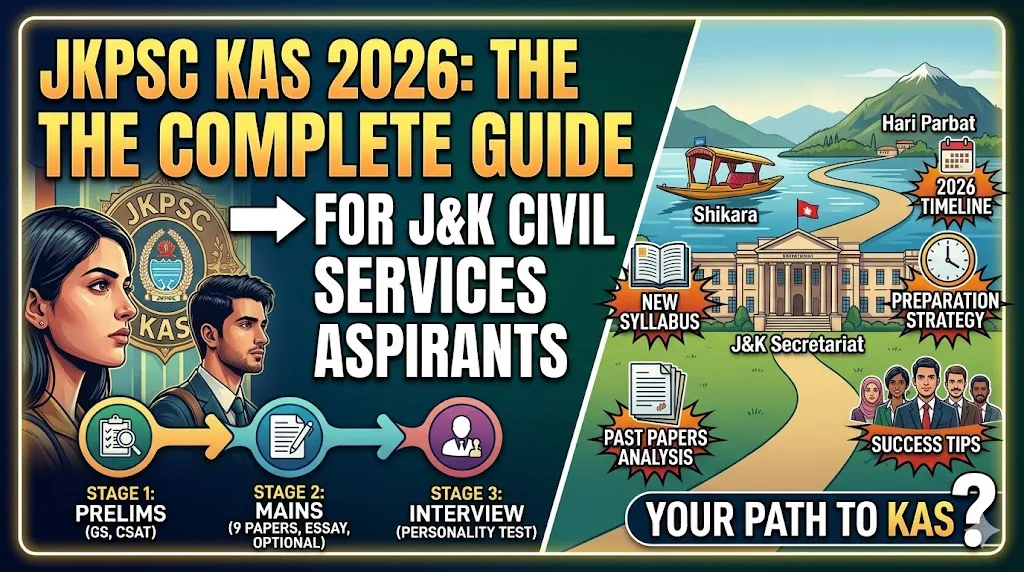
The Kashmir Administrative Service (KAS) examination — conducted by the Jammu & Kashmir Public Service Commission (JKPSC) — is the premier civil services examination for Jammu & Kashmir. Clearing KAS means joining the J&K Administrative Service as a gazetted officer, with postings as Tehsildar, Block Development Officer, and progressing to higher administrative roles within the J&K government.
The KAS exam is the J&K equivalent of what IAS is at the national level — the most prestigious administrative career path for aspirants from the Union Territory.
JKPSC KAS 2026 — Overview
| Detail | Information |
|---|---|
| Conducting Body | Jammu & Kashmir Public Service Commission (JKPSC) |
| Exam | Combined Competitive Examination (CCE) for KAS and Allied Services |
| Services | KAS, J&K Police Service, J&K Accounts Service, J&K Taxation Service, and others |
| Qualification | Graduation from any recognised university |
| Age Limit | 21–37 years (with category relaxations) |
| Domicile | J&K domicile mandatory |
| Official Website | jkpsc.nic.in |
Services Recruited Through JKPSC CCE
The JKPSC Combined Competitive Examination recruits for multiple services in one process:
| Service | Starting Post |
|---|---|
| J&K Administrative Service (KAS) | Tehsildar / BDO level |
| J&K Police Service (JKPS) | Deputy Superintendent of Police (DSP) |
| J&K Accounts Service (JKAS) | Accounts Officer |
| J&K Taxation Service | Taxation Officer |
| J&K Finance Service | Finance Officer |
| J&K Planning & Development Service | Planning & Development Officer |
JKPSC KAS Exam Pattern
The examination has three stages:
Stage 1 — Preliminary Examination (Prelims)
Paper 1 — General Studies (200 marks, 2 hours): Objective MCQ covering: Current Events, History, Geography, Indian Polity, Economy, General Science, Environment, and J&K specific topics.
Paper 2 — CSAT (200 marks, 2 hours):
- Comprehension
- Interpersonal skills and communication
- Logical reasoning and analytical ability
- Decision making
- General mental ability
- Basic numeracy (Class 10 level)
- Qualifying paper — minimum 33% required, marks do not count in Prelims merit
Candidates are shortlisted for Mains based on Paper 1 performance — approximately 12–15 times the number of Mains vacancies.
Stage 2 — Main Examination (Mains)
Compulsory Papers:
| Paper | Subject | Marks |
|---|---|---|
| Paper 1 | Essay | 150 |
| Paper 2 | General Studies I (History, Geography, Society) | 200 |
| Paper 3 | General Studies II (Governance, Constitution, International Relations) | 200 |
| Paper 4 | General Studies III (Economy, Technology, Environment, Security) | 200 |
| Paper 5 | General Studies IV (Ethics, Integrity, Aptitude) | 150 |
| Paper 6 | General English | 100 (qualifying) |
| Paper 7 | General Urdu/Hindi | 100 (qualifying) |
Optional Papers:
| Paper | Subject | Marks |
|---|---|---|
| Paper 8 | Optional Subject Paper 1 | 200 |
| Paper 9 | Optional Subject Paper 2 | 200 |
Total marks (merit papers): 1,400 marks
All Mains papers are descriptive — written answers, not MCQ.
Stage 3 — Personality Test (Viva Voce)
- 150 marks
- Conducted by JKPSC board
- Tests personality, suitability for administrative service, J&K knowledge, and analytical thinking
Final Merit: Mains (1,400) + Personality Test (150) = 1,550 marks total
Complete Syllabus
General Studies Paper 1 — History, Geography & Society
History:
- History of J&K — from earliest times to the present, Dogra rule, Instrument of Accession 1947, political developments post-1947, the reorganisation of 2019
- Indian History — Ancient, Medieval, Modern
- Freedom Struggle — key events, personalities, and their significance
- Post-independence India — major political, economic, and social developments
- World History — industrial revolution, world wars, decolonisation, cold war
Geography:
- Physical geography of India and J&K — mountain ranges, rivers, passes, lakes, climate zones
- Social and economic geography — agriculture, industry, population patterns
- World geography — physical features, major countries, ocean currents, climate
Society:
- Indian society — diversity, regionalism, communalism, social movements
- Women and development
- Poverty and hunger
- Urbanisation and social change
- J&K society — its diversity, tribal communities (Gujjars, Bakkarwals, Shins), cultural traditions
General Studies Paper 2 — Governance, Constitution & International Relations
Indian Constitution:
- Features, historical background, making of the Constitution
- Fundamental Rights and Duties
- Directive Principles of State Policy
- Parliamentary system — Lok Sabha, Rajya Sabha, President, Prime Minister
- State executive and legislature
- Judiciary — Supreme Court, High Courts, judicial review
- Constitutional bodies — Election Commission, UPSC, CAG, Finance Commission
- J&K-specific: The J&K Reorganisation Act 2019 — administrative changes, LG powers, new district structure, impact on governance
Governance:
- Government policies and their implementation
- Role of civil services in democracy
- e-Governance — initiatives and challenges
- Transparency and accountability — RTI, whistleblower protection
- Welfare schemes — national and J&K specific
International Relations:
- India’s foreign policy — principles and evolution
- India and its neighbours — Pakistan, China, Bangladesh, Nepal
- J&K’s geopolitical significance — Line of Control, China border (LAC in Ladakh)
- International organisations — UN, WTO, IMF, World Bank, SCO (J&K’s relevance to SCO)
- India and major powers — USA, Russia, European Union
General Studies Paper 3 — Economy, Technology & Environment
Indian Economy:
- Planning and development — five-year plans, NITI Aayog
- Agriculture — issues, green revolution, land reforms, irrigation
- Industry — industrial policy, MSMEs, Make in India
- Services sector — IT, banking, tourism
- Infrastructure — highways, railways, power sector
- J&K economy specifically: horticulture (apple, saffron, walnut), handicrafts (carpet, pashmina, papier-mâché), tourism, unemployment challenges, central schemes in J&K
Science and Technology:
- Recent developments in science and technology
- Space programme — ISRO’s achievements
- Biotechnology and its applications
- IT and digital India
- Defence technology
Environment:
- Environmental conservation — biodiversity, forests, wetlands
- Climate change — impact on J&K (glacial melt, weather extremes)
- Pollution — air, water, soil
- Disaster management — floods (J&K’s flood vulnerability), earthquakes, landslides
General Studies Paper 4 — Ethics, Integrity & Aptitude
- Ethics in public administration
- Integrity and probity in governance
- Attitude formation and its role in public service
- Emotional intelligence
- Case studies on ethical dilemmas in administration
- Contributions of philosophers and moral thinkers
- Public service values
Essay Paper
Two essays on different topics from the following domains: social issues, philosophical themes, economic policy, J&K specific topics, environmental issues, governance and administration.
Quality of writing, argument structure, and depth of analysis are all evaluated. Essays in JKPSC are typically 800–1000 words each.
Optional Subject Choices
JKPSC offers a range of optional subjects. Popular choices:
- Public Administration
- Sociology
- Geography
- History
- Political Science & International Relations
- Urdu Literature
- Kashmiri Literature
- Economics
- Law
- Philosophy
How to choose: Select based on genuine interest and your academic background. The optional subject accounts for 400 marks — a significant portion of the total. Choose something you can study in depth over months.
J&K Specific Knowledge — Critical for KAS
The JKPSC KAS exam tests J&K knowledge more extensively than any other exam. Prepare specifically:
J&K Reorganisation Act 2019: Know this in depth — what changed (state to two UTs, legislative assembly structure, LG powers, IAS/IPS officers, central laws applicability), what remained, and the administrative implications. This appears in almost every JKPSC paper.
J&K History: From the Dogra period (Maharaja Gulab Singh’s Treaty of Amritsar 1846) through Maharaja Hari Singh, the Instrument of Accession in 1947, the political history through to 2019. Key personalities, key events, and their significance.
J&K Geography: Districts (20 districts after reorganisation), divisions (Jammu and Kashmir), major rivers (Jhelum, Chenab, Tawi, Indus, Kishanganga), mountain ranges (Himalayas, Pir Panjal, Zanskar, Karakoram), important passes, lakes, glaciers.
J&K Economy: Horticulture’s contribution, major crops (apple, saffron, walnut, almond), handicrafts sector (carpet exports, pashmina GI tag), tourism statistics, unemployment rate (higher than national average), central schemes implemented in J&K.
J&K Current Affairs: Read Greater Kashmir and Rising Kashmir regularly. Administrative decisions, new schemes, infrastructure projects (Udhampur-Srinagar-Baramulla Rail Link, road projects), court orders related to J&K — all are fair game.
Eligibility
Qualification: Graduation from any recognised university.
Domicile: Valid J&K domicile certificate mandatory.
Age Limit:
| Category | Age Limit |
|---|---|
| General (OM) | 21–37 years |
| SC/ST | 21–42 years |
| OBC/RBA | 21–40 years |
| PwD (General) | 21–47 years |
| Ex-Servicemen | Age + service period (subject to upper limit) |
Preparation Strategy
Build on UPSC preparation: The JKPSC KAS syllabus overlaps significantly with UPSC Prelims and Mains. Candidates preparing for UPSC will find KAS Prelims very manageable with 3–4 weeks of J&K-specific additional study. The main additional requirement is the depth of J&K knowledge.
J&K GK is the differentiator: Most KAS aspirants have similar national GK preparation. The J&K section — history, geography, economy, current affairs, the Reorganisation Act — is where the merit list is actually decided. Invest disproportionate time here.
Mains answer writing: Practice writing 200-word analytical answers consistently. The JKPSC Mains tests whether you can think through a complex administrative issue and present a structured, reasoned response. Reading is not enough — writing practice is essential.
Optional subject early: Start your optional subject alongside Prelims preparation, not after Prelims results. 400 marks is too large a component to start late.
Official Link
JKPSC Official Website: jkpsc.nic.in
All JKPSC notifications, syllabus PDFs, and results are published here.
Published by ExamzPrep — free government exam preparation for serious aspirants. Last updated June 2026.

Zahid Bhat is the founder of ExamzPrep. He has spent the last 4 years following JKSSB, SSC, Banking, Railway, UPSC, and State PSC recruitment cycles closely — tracking syllabus changes, question paper trends, and notification updates — and has qualified a JKSSB examination himself. ExamzPrep is built on that firsthand preparation experience: honest, free content for self-studying aspirants, with no courses to sell and no coaching to promote.