
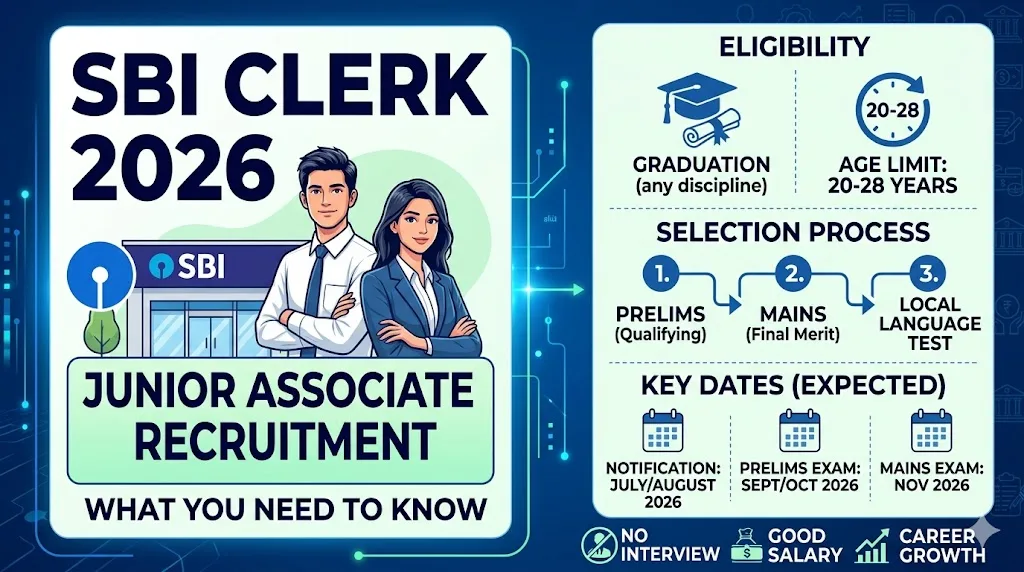
The State Bank of India Junior Associate (Customer Support & Sales) examination — commonly called SBI Clerk — is one of the most applied-for banking recruitment processes in India. With SBI being the country’s largest bank with over 22,000 branches, the number of vacancies in each SBI Clerk cycle is substantial, and the posting locations cover every state and union territory.
SBI Clerk is distinct from IBPS Clerk in one important way — you are applying to join SBI specifically, not a pool of public sector banks. This means your posting will be within SBI, your career progression follows SBI’s internal rules, and the exam is tailored to SBI’s standards.
SBI Clerk 2026 — Overview
| Detail | Information |
|---|---|
| Conducting Body | State Bank of India (SBI) |
| Post | Junior Associate (Customer Support & Sales) |
| Starting Basic Pay | ₹17,900 (in-hand approximately ₹26,000–₹30,000 with allowances) |
| Qualification | Graduation from any recognised university |
| Age Limit | 20–28 years |
| Language Requirement | Proficiency in local language of the state where posting is sought |
| Official Website | sbi.co.in/careers |
SBI Clerk vs IBPS Clerk — Key Differences
| Factor | SBI Clerk | IBPS Clerk |
|---|---|---|
| Employer | Only SBI | 11 public sector banks |
| Vacancies per cycle | 8,000–15,000 typically | 6,000–10,000 typically |
| Local language | Mandatory proficiency test | Required for some banks |
| Difficulty | Slightly higher than IBPS | Moderate |
| Interview | No | No |
| Brand value | Highest among PSU banks | Good across multiple banks |
Should you appear for both? Yes — the Prelims syllabus is nearly identical. Prepare together, apply separately.
SBI Clerk 2026 Exam Pattern
Stage 1 — Preliminary Examination
| Subject | Questions | Marks | Time |
|---|---|---|---|
| English Language | 30 | 30 | 20 minutes |
| Numerical Ability | 35 | 35 | 20 minutes |
| Reasoning Ability | 35 | 35 | 20 minutes |
| Total | 100 | 100 | 60 minutes |
- Sectional time limits apply strictly
- Negative marking: 0.25 per wrong answer
- Qualifying only — Prelims marks do not count in final merit
Stage 2 — Main Examination
| Subject | Questions | Marks | Time |
|---|---|---|---|
| General/Financial Awareness | 50 | 50 | 35 minutes |
| General English | 40 | 40 | 35 minutes |
| Quantitative Aptitude & Data Interpretation | 50 | 50 | 45 minutes |
| Reasoning Ability & Computer Aptitude | 50 | 60 | 45 minutes |
| Total | 190 | 200 | 2 hours 40 minutes |
- Negative marking: 0.25 per wrong answer
- Sectional cutoffs apply
- No interview or descriptive paper — Mains score determines final merit
Stage 3 — Local Language Test (Qualifying)
After Mains shortlisting, candidates must demonstrate proficiency in the official language of the state where they are seeking posting. This is a qualifying test — pass or fail, no marks added to merit.
Complete Syllabus
Reasoning Ability & Computer Aptitude
Reasoning:
- Puzzles — linear seating, circular seating, floor puzzles, box puzzles
- Syllogisms
- Inequalities
- Coding-decoding
- Blood relations
- Direction and distance
- Order and ranking
- Alphanumeric series
- Input-output
- Data sufficiency
Computer Aptitude:
- Computer hardware — CPU, RAM, ROM, input/output devices
- Software — system software, application software
- MS Office — Word, Excel, PowerPoint
- Internet — browsers, email, networking
- Operating systems
- Database basics
- Keyboard shortcuts
- Computer security — malware, firewall, antivirus
Quantitative Aptitude & Data Interpretation
- Data Interpretation — tables, bar graphs, line graphs, pie charts, caselet DI
- Number series
- Quadratic equations
- Approximation and simplification
- Percentages, ratio and proportion
- Profit and loss, discount
- Simple and compound interest
- Time and work, time and distance
- Mixtures and alligation
- Probability
General/Financial Awareness
- RBI — functions, monetary policy, repo rate, reverse repo, CRR, SLR
- Types of banks — commercial, cooperative, RRB, small finance, payment banks
- Banking terms — NPA, MCLR, Basel norms, priority sector lending
- Government schemes — PMJDY, Mudra, Atal Pension, PMSBY, PMJJBY
- Capital markets — SEBI, stock exchanges, mutual funds, bonds
- Insurance — IRDAI, types of insurance
- Recent banking sector news and mergers
- Budget highlights
- Current economic affairs
- International financial organisations — IMF, World Bank, ADB
- SBI-specific: SBI’s history, key milestones, subsidiaries (SBI Life, SBI Cards, SBI Mutual Fund), recent initiatives
General English
- Reading comprehension (multiple passages)
- Cloze test
- Error spotting
- Fill in the blanks
- Vocabulary — synonyms, antonyms, word usage
- Para jumbles
- Sentence improvement
- Paragraph completion
Eligibility
Qualification: Graduation in any subject from any recognised university. Final year students can apply provisionally.
Age: 20 to 28 years.
Age Relaxation:
| Category | Relaxation |
|---|---|
| SC/ST | 5 years |
| OBC | 3 years |
| PwD | 10 years |
| Ex-Servicemen | As per rules |
Local Language: You must be proficient in the official language of the state where you seek posting. SBI conducts a local language test after Mains shortlisting. Candidates who fail this test are not appointed even if they cleared Mains.
Practical implication for J&K candidates: Candidates seeking posting in J&K must demonstrate proficiency in Urdu, Hindi, or Kashmiri depending on the specific requirement in the notification. Read this carefully before applying.
Preparation Strategy
What SBI Clerk Mains Tests Differently
Financial Awareness is SBI-specific: SBI Mains GA section includes questions specifically about SBI — its history, subsidiaries, recent acquisitions, key products, and initiatives. This is tested more than in IBPS Clerk. Spend 1–2 focused weeks on SBI-specific awareness.
Reasoning complexity is higher than IBPS Clerk: SBI Clerk Mains reasoning puzzles are consistently harder than equivalent IBPS papers. Complex multi-parameter puzzles (5–6 variables) appear regularly. Practice harder puzzle sets specifically.
Data Interpretation quality: SBI Clerk Mains DI includes caselet-based sets (text describing data rather than a table or graph). Practice reading and extracting data from caselets specifically — this is less common in IBPS but regular in SBI papers.
Prelims Strategy (30-day intensive)
Sectional limits are strict: 20 minutes per section with no overflow. Practice each section independently under exactly 20 minutes before attempting full papers.
Reasoning first: Most candidates find Reasoning the most time-consuming section. Attempt it with full energy in your 20-minute window. Complete the puzzles you know quickly, flag the complex ones, and return if time permits.
Numerical — simplification first: Simplification and approximation questions (5–7 in Prelims) take under 30 seconds each if practiced. Solve these first to secure quick marks before moving to calculation-heavy topics.
English — comprehension last: Comprehension passages take more time per mark than vocabulary and grammar questions. Attempt vocabulary, error spotting, and fill in the blanks first, then comprehension with remaining time.
Local Language Preparation
If you are applying for posting in a non-home state or in a state where you are not fully proficient in the official language, address this early. The local language test is qualifying — failing it eliminates you regardless of Mains score.
Books Recommended
| Subject | Book |
|---|---|
| Reasoning | SBI Clerk Previous Papers + Oliveboard mock series |
| Quantitative Aptitude | R.S. Aggarwal or Arun Sharma (DI sections) |
| English | SP Bakshi — Objective English |
| Financial/Banking Awareness | Arihant Banking Awareness + SBI annual report |
| Mock Tests | SBI Clerk previous papers + online mocks |
Official Link
SBI Careers: sbi.co.in/careers
Published by ExamzPrep — free government exam preparation for serious aspirants. Last updated June 2026.

Zahid Bhat is the founder of ExamzPrep. He has spent the last 4 years following JKSSB, SSC, Banking, Railway, UPSC, and State PSC recruitment cycles closely — tracking syllabus changes, question paper trends, and notification updates — and has qualified a JKSSB examination himself. ExamzPrep is built on that firsthand preparation experience: honest, free content for self-studying aspirants, with no courses to sell and no coaching to promote.