
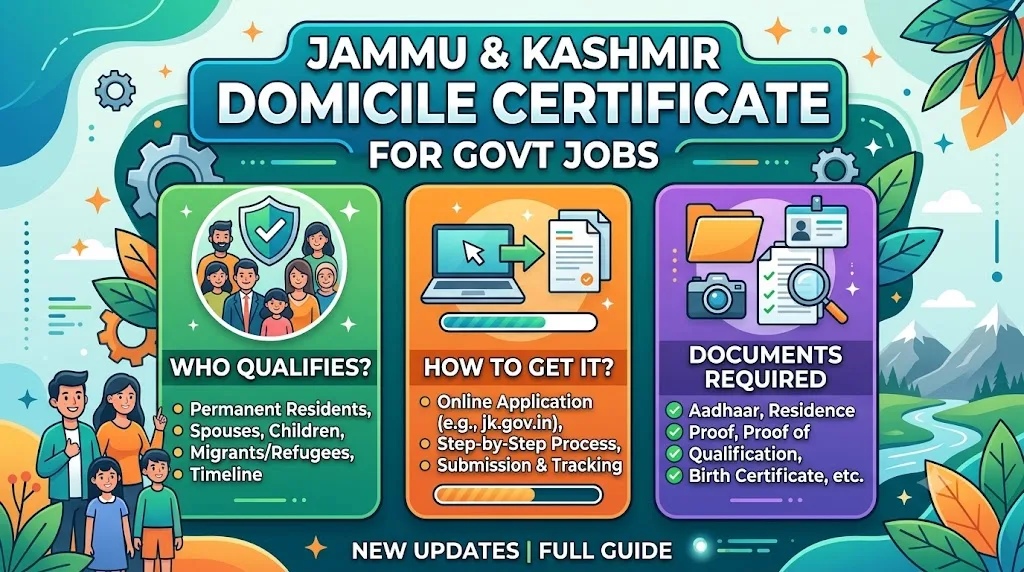
If you are preparing for any government job in Jammu and Kashmir — whether under JKSSB, JKPSC, or any other UT-level recruiting body — there is one document that matters more than your degree certificate, your mark sheets, or even your exam score. Without a valid J&K Domicile Certificate, your application will simply not be considered, regardless of how well you perform.
This is not a technicality that can be sorted at the last minute. The certificate has to be applied for, verified, and issued before you submit any job application. Many aspirants discover this requirement only after a notification is already live, which leaves them scrambling through a process that takes weeks under normal circumstances.
This guide explains exactly who qualifies for a J&K Domicile Certificate, what documents you need to gather, how to apply both online and offline, how long the process takes, and what role this certificate plays in government recruitment across the Union Territory.
What Is the J&K Domicile Certificate
The J&K Domicile Certificate is an official document issued by the Government of Jammu and Kashmir that legally certifies an individual as a permanent resident of the Union Territory. It replaced the earlier Permanent Resident Certificate system that existed when J&K was a full state.
The shift happened following two major legal developments. The Jammu and Kashmir Reorganisation Act of 2019 restructured the state into two Union Territories — Jammu and Kashmir, and Ladakh. This was followed in 2020 by the notification of the J&K Grant of Domicile Certificate (Procedure) Rules, which defined who qualifies for domicile status under the new framework and significantly broadened the eligibility base compared to the earlier PRC system.
The domicile certificate now serves as the primary eligibility gateway for all UT government jobs, reserved seats in local educational institutions, state scholarships, and various welfare schemes administered by the J&K government.
Why It Is Mandatory for Government Jobs
Every single post advertised by JKSSB — from Class IV multi-tasking staff to Junior Engineer — requires a valid J&K Domicile Certificate as a foundational eligibility condition. The same applies to JKPSC, J&K High Court recruitment, and all other UT-level recruiting bodies.
Unlike central government exams such as SSC, UPSC, or banking recruitments, which are open to any Indian citizen, J&K government jobs are reserved for domicile holders. This reservation is not category-based — it applies to the post itself. A general merit candidate from another state cannot apply, regardless of their qualifications. The domicile certificate is the document that proves your legal right to compete for these posts.
During document verification after result declaration, submitting a valid, original domicile certificate is compulsory. Applications where this certificate is missing, expired, or issued by an incompetent authority are liable to be rejected at any stage of the recruitment process — including after selection.
Who Qualifies: Eligibility Categories
The J&K Grant of Domicile Certificate (Procedure) Rules 2020 define several categories of eligibility. If you fall under any one of the following, you are eligible to apply.
Category 1: Long-Term Residents
Any person who has resided in the Union Territory of Jammu and Kashmir for fifteen years or more, along with their children, is eligible for domicile status. This is the most straightforward eligibility route for lifelong residents of the UT.
Category 2: Students Who Studied in J&K
Any person who has studied in an educational institution located in J&K for a period of seven years, and who has appeared in their Class 10 or Class 12 board examination from a J&K institution, qualifies for domicile. This category specifically covers students whose family may not have resided in J&K for the full fifteen-year period but who completed a significant portion of their schooling here.
Category 3: Registered Migrants
Any person who is registered as a migrant with the Relief and Rehabilitation Commissioner (Migrants) in Jammu and Kashmir, along with their children, is eligible. This covers Kashmiri Pandit migrants and other displaced communities who registered with the authorities after leaving J&K.
Category 4: Children of Central Government and Other Service Personnel
Children of the following categories of officials who have served in Jammu and Kashmir for a cumulative period of ten years are eligible for domicile status:
- Central Government employees
- All India Service officers
- Officials of Public Sector Undertakings (PSUs) and autonomous bodies of the Central Government
- Officers of public sector banks
- Officials of central universities and recognised research institutes of the Central Government
- Officials of statutory bodies under the Central Government
It is important to note that it is the children of these officials who qualify — not the officials themselves — provided the parent’s service in J&K meets the ten-year threshold.
Category 5: Children of J&K Residents Living Outside the UT
Children of J&K residents who currently reside outside the Union Territory due to employment, business, or other professional or vocational reasons are eligible. This ensures that native J&K families who temporarily relocated for work do not lose their domicile status and that their children can still claim it.
Category 6: West Pakistan Refugees, Valmikis, and Displaced Persons
Children of West Pakistan Refugees who settled in J&K, Valmiki community members, families displaced from Pakistan-occupied Kashmir, and other similar categories of displaced persons are eligible for domicile status under the 2020 rules.
Eligibility Summary Table
| Category | Key Condition |
|---|---|
| Long-term residents | 15 years of continuous residence in J&K |
| Students | 7 years of study + appeared in Class 10 or 12 from J&K institution |
| Registered migrants | Registered with Relief and Rehabilitation Commissioner, J&K |
| Children of Central Govt service officials | Parent served in J&K for cumulative 10 years |
| Children of J&K natives living outside UT | Parent is J&K resident, living outside for employment or business |
| West Pakistan Refugees and displaced persons | Settled in J&K under applicable provisions |

Documents Required
Preparing the correct documents before you visit the Tehsildar’s office or apply online saves significant time. The following documents are generally required across all eligibility categories, with some variation depending on which category applies to you.
For All Applicants
- Duly filled domicile certificate application form (Form A)
- Proof of identity — Aadhaar Card, Voter ID, or Passport
- Recent passport-size photographs
- Self-declaration or affidavit as required in the application form
For Residency-Based Applicants (15-Year Residence)
- Proof of residence covering the claimed period — this can include ration card, electricity bills, property documents, bank passbooks, or voter ID issued from J&K address
- Revenue record or house ownership documents where applicable
- Aadhaar Card showing J&K address
For Students (7-Year Study Route)
- School certificates showing enrollment dates confirming at least 7 years of study in a J&K institution
- Mark sheet and passing certificate of Class 10 or Class 12 examination from a J&K board
- Character certificate from the school or institution
For Children of Central Government and Service Officials
- Service certificate of the parent clearly showing period of posting in J&K
- Appointment order or posting orders mentioning J&K as the place of service
- Proof of relationship — birth certificate or family ration card
For Registered Migrants
- Migration certificate issued by the Relief and Rehabilitation Commissioner, J&K
- Registration document as a migrant
- Identity proof and photographs
For Children of J&K Residents Living Outside
- Proof that the parent is a J&K native — such as an old domicile certificate, PRC, or ancestral property document
- Proof that the parent resides outside J&K due to employment or business — such as employer certificate or trade licence from another state
- Proof of relationship between applicant and parent
How to Apply: Online Method
The J&K government has digitised the domicile certificate application process through two official portals — the Jansugam Portal and the J&K e-Services portal. The online route is faster, eliminates multiple office visits, and allows you to track your application status from home.
Step 1: Visit the Jansugam Portal at jansugam.jk.gov.in
Step 2: Register using the MeriPehchaan national single sign-on system if you are a first-time user. Enter your basic details and create login credentials.
Step 3: Log in and navigate to the section for citizen services. Search for the domicile certificate service.
Step 4: Fill in the online application form carefully. Ensure all personal details — name, date of birth, address, category of eligibility — are entered exactly as they appear in your supporting documents.
Step 5: Upload scanned copies of all required documents. Files should be clear, complete, and within the size limits specified on the portal.
Step 6: Submit the application and save the acknowledgment reference number. This number is used to track your application status later.
Step 7: The application is forwarded to the concerned Tehsildar’s office, where a Revenue Inspector or local authority may conduct field verification of your declared residence or service details.
Step 8: Upon successful verification, the domicile certificate is issued digitally and can be downloaded from the portal.
How to Apply: Offline Method
For applicants who prefer a physical process, or who face difficulties with the online portal, the offline route remains available.
Step 1: Visit your nearest Tehsildar’s office or Jan Seva Kendra within your jurisdiction.
Step 2: Obtain the domicile certificate application form (Form A) from the office counter, or download it from the official J&K Revenue Department website.
Step 3: Fill the form carefully using capital letters where required. Cross-check all entries against your original documents before writing.
Step 4: Attach self-attested photocopies of all required documents in the correct order. Keep originals available for verification at the counter.
Step 5: Submit the completed form along with documents at the Tehsildar’s office. Collect your acknowledgment receipt and note the application reference number.
Step 6: A Revenue Inspector may be assigned to visit your declared address to verify your residency or other eligibility claims. Be available and ensure that neighbours or landlords can corroborate your residency period if asked.
Step 7: After verification is complete, the certificate is issued either in physical form or uploaded to the portal for download.
Processing Time and Timelines
The official rules mandate that domicile certificates must be issued within fifteen days of application submission. Delays beyond this statutory timeline are treated seriously — the appellate authority is empowered to take action against the issuing officer in cases of unjustified delay.
In practice, processing can take anywhere from fifteen to thirty days depending on the volume of applications at your Tehsildar’s office and the complexity of field verification needed. If your eligibility is straightforward — long-term residence with clear documentary proof — the process generally stays within the statutory fifteen-day window. More complex cases involving migrant registration or service records of government officials may take longer.
If you have not received your certificate within fifteen days of submission and have received no communication, you may approach the appellate authority designated under the 2020 rules with your acknowledgment receipt.
How to Track Your Application Status
For online applications submitted through the Jansugam Portal:
- Log in to your account on jansugam.jk.gov.in
- Click on the Track Application option on the homepage
- Select the option to track by Application Reference Number
- Enter your reference number and submission date
- The current status of your application will be displayed
For offline applications, contact the Tehsildar’s office directly with your acknowledgment receipt and reference number.
Common Reasons for Rejection
Understanding why applications get rejected helps you avoid the same mistakes.
| Reason for Rejection | How to Avoid It |
|---|---|
| Incomplete or incorrectly filled application form | Double-check every field before submission; match entries exactly to your documents |
| Blurry or partial scanned documents uploaded | Re-scan documents at high resolution; ensure every page is complete and legible |
| Insufficient proof of residence duration | Gather multiple documents covering the full claimed period, not just recent ones |
| Mismatch between name in form and supporting documents | Use the same name spelling consistently across all documents |
| Missing relationship proof for dependent applicants | Always include birth certificate or ration card showing parent-child relationship |
| Parent’s service record not clearly mentioning J&K posting | Request a specific letter from the parent’s employer mentioning J&K service period |
Key Differences: Old PRC vs New Domicile Certificate
Many older candidates from J&K are familiar with the earlier Permanent Resident Certificate. The two systems differ in important ways.
| Aspect | Old PRC | New Domicile Certificate |
|---|---|---|
| Legal basis | J&K Constitution and State Subject Rules | J&K Reorganisation Act 2019 + 2020 Rules |
| Eligibility scope | Narrower — primarily hereditary state subjects | Broader — includes 15-year residents, students, service officials’ children |
| Issuing authority | Tehsildar / SDM | Tehsildar (same) |
| Applicability | State government jobs and benefits | UT government jobs and benefits |
| Current validity | Not valid for new government jobs | Required for all new government appointments in J&K UT |
If you hold an old PRC, it does not automatically serve as a domicile certificate for purposes of new government recruitments. You need to apply for the new domicile certificate under the 2020 rules.
Key Takeaways
- The J&K Domicile Certificate is mandatory for every government job advertised by JKSSB, JKPSC, and all other UT-level recruiting authorities — no exceptions
- Eligibility is based on six main categories: 15-year residence, 7-year schooling in J&K, registered migrant status, children of Central Government service officials with 10-year J&K posting, children of J&K natives living outside, and certain displaced communities
- Applications can be submitted online through the Jansugam Portal or offline at the Tehsildar’s office in your jurisdiction
- The statutory issuance timeline is fifteen days, though practical timelines can extend to thirty days depending on verification requirements
- The old Permanent Resident Certificate is not equivalent to the new Domicile Certificate — a fresh application is necessary
- Gather all documents before applying, ensure clarity and completeness, and keep your acknowledgment receipt safely
Conclusion
The J&K Domicile Certificate is not a formality — it is the single document that determines whether you can even apply for a government job in the Union Territory. Given that processing takes anywhere from two to four weeks under normal circumstances, aspirants should apply as early as possible rather than waiting for a JKSSB notification to go live before thinking about it.
If you are currently in Class 12 or in the final year of your graduation and you intend to appear for J&K government exams, apply for your domicile certificate now. If you already hold an old PRC and believe that covers you, verify with your Tehsildar whether a fresh domicile application is required for current recruitment purposes. Getting this right in advance, rather than under time pressure, removes one significant source of stress from an already competitive process.
Frequently Asked Questions
1. Is the J&K Domicile Certificate different from the old Permanent Resident Certificate?
Yes. The Permanent Resident Certificate was issued under the old state subject rules when J&K was a full state. The Domicile Certificate was introduced under the J&K Grant of Domicile Certificate (Procedure) Rules 2020, following reorganisation. For new government job appointments, the new Domicile Certificate is required — the old PRC is not treated as an equivalent.
2. Can someone who was born outside J&K but studied there for seven years qualify for a Domicile Certificate?
Yes, provided they studied in a J&K institution for at least seven years and appeared in their Class 10 or Class 12 examination from a J&K board. The place of birth is not a disqualifying factor under this category.
3. My father is a Central Government employee who was posted in J&K for twelve years. Am I eligible?
Yes. Children of Central Government employees, All India Service officers, PSU officials, and officials of statutory bodies who have served in J&K for a cumulative period of ten years are eligible for domicile status. A twelve-year posting clearly meets this requirement.
4. How long is the Domicile Certificate valid?
Once issued, the J&K Domicile Certificate does not carry a standard expiry date in the way that income or caste certificates do. However, for specific government recruitment purposes, always check the relevant notification, as some recruitments may specify a maximum age of the certificate they will accept.
5. What should I do if my application is rejected?
If your domicile application is rejected, you will receive a written order stating the reason. You may appeal against this decision to the appellate authority designated under the 2020 rules — typically the Sub-Divisional Magistrate or a higher revenue authority — within the time limit specified in the rejection order. Attach the rejection order and any additional supporting documents with your appeal.
Official Resources
- J&K Jansugam Online Services Portal — jansugam.jk.gov.in
- J&K e-Services Portal — jk.gov.in/jkeservices
- J&K Revenue Department — jkrevenue.nic.in
- JKSSB Official Website — jkssb.nic.in
- J&K Law Department (Domicile Rules PDF) — jklaw.nic.in

Zahid Bhat is the founder of ExamzPrep. He has spent the last 4 years following JKSSB, SSC, Banking, Railway, UPSC, and State PSC recruitment cycles closely — tracking syllabus changes, question paper trends, and notification updates — and has qualified a JKSSB examination himself. ExamzPrep is built on that firsthand preparation experience: honest, free content for self-studying aspirants, with no courses to sell and no coaching to promote.