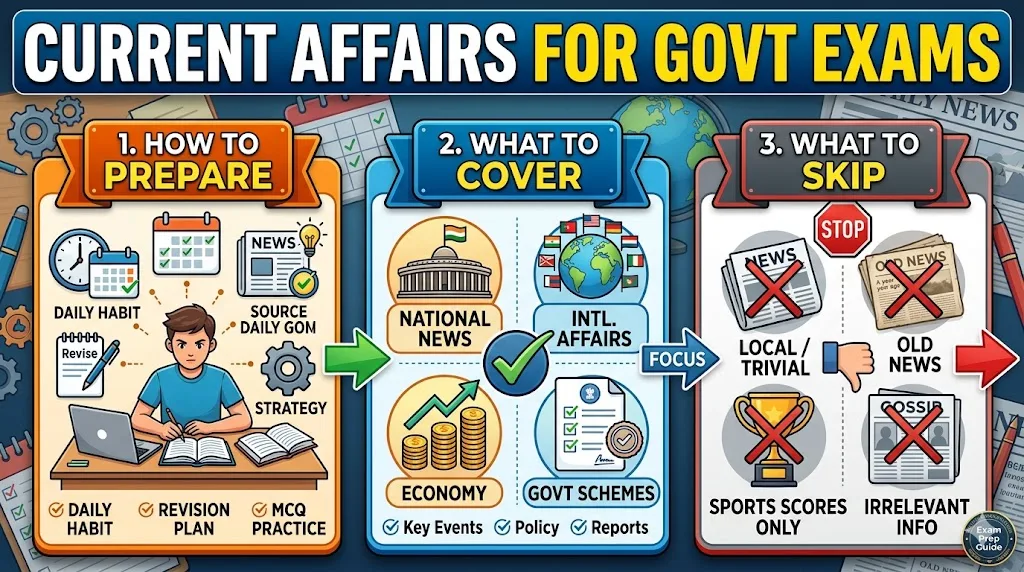
Current affairs is the section that most aspirants prepare least effectively. The problem is not lack of effort — most candidates read newspapers or watch news daily. The problem is retention and relevance. Reading without a system produces familiarity without recall. And covering everything produces so much information that nothing sticks.
This guide builds a current affairs preparation system that is efficient, exam-relevant, and actually works.
How Much Current Affairs Matters — Exam-wise
Before building a system, know how much current affairs actually counts in your target exam:
| Exam | Current Affairs Weightage | Window Covered |
|---|---|---|
| SSC CGL / CHSL | 30–40% of GK section | Last 6 months |
| IBPS PO / Clerk | 40–50% of GA section | Last 6 months |
| RRB NTPC / Group D | 30–40% of GA section | Last 6 months |
| UPSC Prelims | 20–25% of Paper 1 | Last 12 months |
| JKPSC KAS | 25–30% of GK section | Last 12 months |
| State PSCs | 25–35% of GK section | Last 6–12 months |
The window covered (last 6 or 12 months before the exam) is more important than any specific topic — always check recent notification-level cut-off dates.
The Problem With Standard Current Affairs Preparation
Problem 1: Reading without reviewing Most aspirants read current affairs daily but never go back to review what they read. Human memory without review decays rapidly — 70% of new information is forgotten within 24 hours without reinforcement. Daily reading without weekly review produces almost no long-term retention.
Problem 2: Covering everything The news cycle produces hundreds of events daily. Trying to cover everything produces volume without depth. Most current affairs questions in government exams come from a predictable set of categories — knowing these categories lets you filter what matters.
Problem 3: Wrong sources Reading full-length newspaper articles for current affairs exam preparation is inefficient — you spend 80% of time on analysis and opinion that is not tested. What is tested is the factual core: who, what, when, where. A structured monthly current affairs digest is more efficient than a newspaper for exam preparation.
The High-Priority Categories for Government Exams
Not all news is equal in exam terms. These categories produce the highest proportion of current affairs questions across SSC, Banking, Railway, and PSC exams:
1. Government Schemes and Policies
Every new central government scheme, policy launch, or significant policy change is high-probability in current affairs. Key details to note:
- Scheme name and full form
- Launched by / implementing ministry
- Target beneficiary group
- Key features — amount, eligibility, benefit
- Launch date
Why high-priority: Government exams predictably test the schemes of the government in power. Every SSC, IBPS, and Railway exam in recent years has had 4–8 questions on central government schemes.
2. Appointments and Elections
- New heads of constitutional bodies (President, Vice President, CJI, CAG, CEC, RBI Governor, SEBI Chairman)
- New heads of important organisations (ISRO, DRDO, major PSUs)
- State election results
- International election results (US, UK, major economies)
- New heads of state governments (Chief Ministers)
Why high-priority: These appear in every government exam GA section without exception.
3. Awards and Recognition
- Bharat Ratna, Padma Awards (announced in January)
- Nobel Prizes (announced in October)
- National and international sports awards
- Film awards (National Film Awards, international film festivals)
- Civilian awards specific to your state for state PSC exams
4. Defence and Security
- New defence acquisitions and indigenous development
- Military exercises — bilateral and multilateral (with India as participant)
- New military chief appointments
- Major security operations
- India’s defence exports (significant increase in recent years)
5. Economy and Finance
- RBI policy decisions — repo rate, CRR, SLR changes
- Union Budget highlights (announced in February — very high probability)
- Economic survey highlights
- GDP growth rate announcements
- Major economic agreements — trade deals, FTA
6. International Relations
- State visits — which foreign leader visited India, which Indian leader went where
- Bilateral agreements signed
- India’s position in international groupings — G20, SCO, BRICS, QUAD
- India’s stand on major international issues
7. Science and Technology
- ISRO missions and results (very high priority — appears in almost every exam)
- DRDO achievements
- India’s ranking in technology indices
- New technology launches relevant to governance (digital India, UPI milestones)
8. Sports
- Major tournament winners — cricket (ICC tournaments), football (FIFA), Olympics, Commonwealth Games, Asian Games
- India’s medal winners in international competitions
- Newly appointed sports federation heads
- Records broken by Indian athletes
9. Environment
- New protected areas, wildlife sanctuaries, national parks declared
- India’s climate commitments and achievements
- Major environmental reports (State of India’s Environment, etc.)
- COP decisions relevant to India
The Efficient Current Affairs System
Daily (15–20 minutes)
Read a structured current affairs summary — not a full newspaper. Options:
- Inshorts (app) — 60-word news summaries
- PIB (Press Information Bureau) daily bulletins — government-focused, high accuracy
- One national newspaper’s “in brief” or “digest” section
What to look for while reading: Anything from the 9 categories above. Mark it mentally.
Weekly (30 minutes, one day per week)
Review what you read during the week. Without weekly review, daily reading is largely wasted. Method:
- Go back to your notes or the week’s summaries
- Write down 10 key facts from the week (scheme names, appointments, sports results)
- Quiz yourself without looking at notes
- Identify what you could not recall — review those specifically
Monthly (2 hours, at month end)
Download or buy a monthly current affairs digest (Pratiyogita Darpan, Arihant Monthly Current Affairs, GKToday Monthly) and read it cover to cover. Monthly digests are curated for exam relevance — they filter out the noise and focus on what is likely to be tested.
Create a one-page summary of the month’s most important events in each category.
State-Specific Current Affairs for PSC Exams
For state PSC exams, standard national current affairs preparation is not enough. You need a separate system for state-level current affairs.
Sources for state current affairs:
- State government’s official website — new scheme launches, policy decisions
- State assembly proceedings summaries (when in session)
- Local English newspapers — for J&K: Greater Kashmir, Rising Kashmir; for UP: The Pioneer Lucknow edition; for Bihar: Times of India Patna edition
- PIB regional office press releases for your state
What to cover:
- New state government schemes
- State budget highlights
- Infrastructure projects in the state
- High Court judgments significant to the state
- State-level appointments
- Cultural events, awards to state personalities
Revision Strategy — The Most Important Part
Reading current affairs is easy. Retaining it for exam day is the challenge.
Three-level revision:
Level 1 — Day after reading: Before reading new content, recall 5 facts from yesterday without looking at notes. This takes 3 minutes and dramatically improves retention.
Level 2 — Weekly review: As described above — review the week’s content, self-quiz, identify gaps.
Level 3 — Monthly consolidation: The end-of-month review and summary. This is the most important — monthly digests and your own notes together form the revision base for exam time.
Final month before exam: Do not read new current affairs in the last 2 weeks before the exam. Revise what you have already covered — your monthly summaries, your notes, your marked digest pages. New content in the final days creates anxiety without adding meaningful marks.
What NOT to Cover
Current affairs preparation is as much about filtering out as it is about including.
Skip these for standard government exams:
- District-level news (unless appearing for district-level recruitment)
- Celebrity news (unless it involves an award)
- Business news that is not about major economic indicators, government policy, or major Indian companies
- International news that has no India connection
- Sports news about tournaments where India did not participate
Cover these specifically:
- Anything where India won, achieved, ranked, or was mentioned internationally
- Any appointment to a constitutional or statutory body
- Any new government scheme or programme
- Any ISRO or DRDO achievement
- Any major natural disaster with significant impact (floods, earthquakes) in India
Current Affairs Resources — Ranked by Usefulness for Exams
| Resource | Best For | Cost |
|---|---|---|
| PIB daily bulletins | Government schemes, policies | Free |
| Monthly digest (Arihant/Pratiyogita) | Curated exam-relevant content | ₹40–₹80/month |
| Inshorts app | Quick daily overview | Free |
| GKToday.in | Banking and SSC specific | Free |
| The Hindu | UPSC and State PSC in-depth | ₹20–₹25/day |
| Jagran Josh monthly | Hindi medium aspirants | ₹30–₹50/month |
For most SSC, Railway, and Banking aspirants: PIB bulletins + one monthly digest + weekly self-review is sufficient. For UPSC and State PSC: Add The Hindu daily reading.
Published by ExamzPrep — free government exam preparation for serious aspirants. Last updated June 2026.

Zahid Bhat is the founder of ExamzPrep. He has spent the last 4 years following JKSSB, SSC, Banking, Railway, UPSC, and State PSC recruitment cycles closely — tracking syllabus changes, question paper trends, and notification updates — and has qualified a JKSSB examination himself. ExamzPrep is built on that firsthand preparation experience: honest, free content for self-studying aspirants, with no courses to sell and no coaching to promote.