
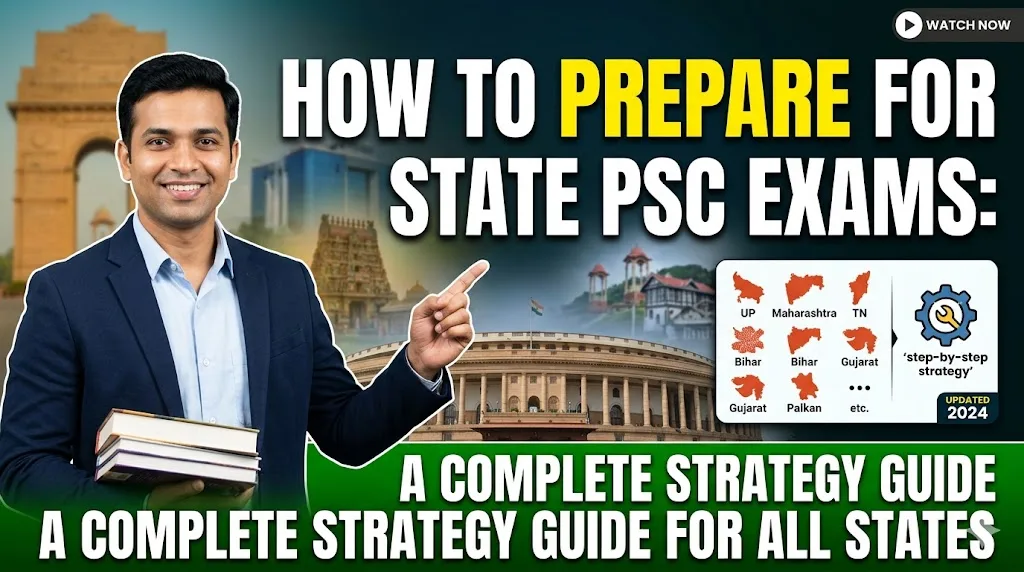
Every state in India has its own Public Service Commission — UPSC for the centre, and a State PSC for each state or Union Territory. These commissions recruit gazetted and non-gazetted officers for state government services — from the State Administrative Service and State Police Service to State Forest Service, State Finance Service, and dozens of other departments.
State PSC exams are among the most competitive and most rewarding government recruitment processes available. This guide covers how to prepare effectively for any State PSC exam — with specific focus on JKPSC, UPPSC, MPPSC, BPSC, RPSC, and other major State PSCs.
What All State PSC Exams Have in Common
Despite differences in syllabus specifics, all State PSC exams follow the same three-stage structure:
Stage 1 — Preliminary Examination: Objective MCQ, eliminates most candidates, shortlists for Mains.
Stage 2 — Main Examination: Descriptive papers — General Studies, optional subject, essay, language papers. This is where selection actually happens.
Stage 3 — Personality Test / Interview: Final stage, typically 100–200 marks.
All State PSCs test five broad areas: History, Geography, Polity, Economy, and General Science — with heavy emphasis on the state’s own history, geography, economy, culture, and current affairs.
The State-Specific GK Component — Most Important Differentiator
Every State PSC exam has a state-specific General Knowledge section that carries 20–35% of the total marks in Prelims. This section is where the state PSC exam separates itself from UPSC and where serious preparation pays off most.
What state-specific GK covers:
History of the state:
- Pre-colonial history — rulers, dynasties, important events
- Colonial period — impact of British rule, freedom fighters from the state, major events
- Post-independence — statehood, reorganisation, major political developments
Geography of the state:
- Physical geography — mountain ranges, rivers, lakes, forests, mineral resources
- Economic geography — major crops, industries, natural resources
- Administrative geography — districts, divisions, major cities, important institutions
Economy of the state:
- Major industries and their contribution to state GDP
- Agricultural produce — cash crops, food crops, irrigation systems
- Poverty, unemployment, and development indicators
- State budget highlights and major schemes
Culture and heritage:
- Festivals, folk arts, classical arts, traditional crafts
- Famous personalities — writers, artists, scientists, freedom fighters
- UNESCO heritage sites, important monuments, museums
Current affairs specific to the state:
- Recent administrative decisions, new schemes, policy changes
- Infrastructure projects, court judgments related to the state
- State politics — elections, government changes, major appointments
State-wise Preparation Focus
JKPSC (Jammu & Kashmir PSC)
State-specific focus:
- J&K Reorganisation Act 2019 in complete detail
- Dogra history, Maharaja Hari Singh, Instrument of Accession 1947
- J&K geography — all 20 districts, major rivers (Jhelum, Chenab, Tawi), mountain passes
- Economy — horticulture (apple, saffron, walnut), handicrafts (pashmina, carpet), tourism
- Current affairs — read Greater Kashmir and Rising Kashmir regularly
Key resource: JKPSC official syllabus from jkpsc.nic.in
UPPSC (Uttar Pradesh PSC)
State-specific focus:
- UP’s role in Indian freedom struggle — Meerut, Lucknow, Varanasi connections
- Geography — Gangetic plain, Eastern UP, Bundelkhand, major rivers
- Economy — sugarcane, wheat, UP industrial corridor, ODOP (One District One Product)
- Culture — Braj, Awadhi, Bhojpuri traditions, classical music (Banaras gharana), Kathak
Key resource: UPPSC syllabus + UP GK books by local publishers
BPSC (Bihar PSC)
State-specific focus:
- Ancient Bihar — Magadha, Pataliputra, Mauryan Empire, Nalanda, Vikramshila
- Bihar’s contribution to freedom struggle — Champaran Satyagraha, JP movement
- Geography — North Bihar plains, South Bihar plateau, Gandak, Kosi, Son rivers
- Economy — agriculture (paddy, wheat, maize), Bihar’s industrial backwardness and development plans
MPPSC (Madhya Pradesh PSC)
State-specific focus:
- MP history — Chandela, Paramar, Holkar, Scindia dynasties
- Tribal communities of MP — Gond, Bhil, Baiga, Korku — their culture and rights
- Geography — Vindhya range, Satpura range, Narmada river
- Economy — soybean, wheat, mineral resources (diamond, coal, manganese)
- Culture — Khajuraho, Sanchi, Ujjain — cultural and religious significance
RPSC (Rajasthan PSC)
State-specific focus:
- Rajput history — major dynasties, battles, palace architecture
- Geography — Thar Desert, Aravalli range, Chambal, Banas rivers
- Economy — tourism, handicrafts, mining (marble, sandstone, zinc)
- Culture — folk music (Rajasthani folk songs), folk dance (Ghoomar, Kalbelia), festivals
Prelims Preparation Strategy (State PSC)
National GK — The Common Foundation
The national GK portion (History, Geography, Polity, Economy, Science) is similar across all State PSC Prelims and overlaps heavily with UPSC Prelims. Build this foundation first:
- History: NCERTs (Class 6–12) + Spectrum for Modern History + Bipin Chandra for Freedom Struggle
- Geography: NCERTs (Class 6–12) + Atlas for map-based questions
- Polity: Laxmikanth — Indian Polity (standard reference for all PSC exams)
- Economy: Ramesh Singh — Indian Economy + NCERT Class 11–12 Economics
- Science: NCERTs Class 9–10
State GK — Build Separately
After building the national foundation, spend dedicated time on state-specific content:
- Find a state-specific GK book from a reputed local publisher
- Read state newspapers (local language or English editions published from your state capital)
- Maintain a separate notes file for state-specific facts — add to it regularly
- Study the state government’s official website for current schemes and programs
- Practice previous year state PSC papers — the state-specific question pattern repeats
CSAT / Aptitude Paper
Most state PSCs have a qualifying aptitude paper (similar to UPSC CSAT) — typically requiring 33% to qualify. Cover basic comprehension, logical reasoning, and arithmetic. Do not over-invest time here — clear the qualifying bar and move on.
Mains Preparation Strategy
Answer Writing Is Everything
State PSC Mains is a written examination — descriptive answers, not MCQ. The single biggest mistake aspirants make is spending all their time reading and no time writing.
Target: Write at least one structured answer daily from the 3rd month of preparation onward.
How to practice answer writing:
- Pick a question from a previous year State PSC Mains paper
- Think about the answer structure (introduction, body points, conclusion) before writing
- Write the answer within the word limit (usually 150–250 words)
- Compare your answer with model answers or UPSC toppers’ approaches
- Identify what was missing — depth of analysis, specific examples, conclusion
General Studies Papers
Most State PSC Mains have 3–4 GS papers covering History/Culture, Governance/Polity, Economy/Environment, and Ethics. The pattern mirrors UPSC GS papers but with heavy state-specific content in each paper.
For each GS paper:
- Know the official syllabus topics precisely
- Identify 5–7 most important topics per paper from previous year analysis
- Build a notes sheet for each topic — standard answer structure with key facts and examples
- Practice answers specifically using state-level examples wherever possible
Optional Subject
One optional subject (2 papers, 200 marks each = 400 marks total in most state PSCs) is the second-largest scoring component after the GS papers. Choose based on genuine interest and background — not on what seems “scoring.”
Preparing the optional:
- Get the official syllabus and match it against the source books
- Standard reference books for each topic
- Previous year optional papers from your state PSC — very useful for understanding depth expected
- Answer writing practice — at least 2 optional answers per week
Essay
Most state PSCs include an essay paper. The essays test your ability to develop an argument, organise ideas, and write clearly. Practice one essay per week from 2 months before Mains. Topics are typically drawn from current affairs, social issues, and philosophical themes.
Interview / Personality Test
State PSC interviews typically test:
- Knowledge of the state — history, current affairs, administrative challenges
- Why you want to join the state civil service
- Your academic background and optional subject
- Current affairs and national issues
- Situational and ethical questions
Preparation: Know your state extremely well — not just the textbook version but current issues, recent government decisions, major development projects, and ongoing challenges. The interview panel will probe your J&K or UP or Bihar knowledge in depth.
Common Mistakes in State PSC Preparation
Ignoring state-specific content: Most aspirants prepare generic UPSC-level GK without adequate state-specific preparation. The state section is 25–35% of Prelims marks — this is where most candidates lose.
Not practising answer writing: Reading without writing leads to poor Mains performance. Start writing from month 3, not month 12.
Choosing optional without thinking: The optional subject is 400 marks — nearly a third of Mains total. Choosing based on what others are choosing rather than your own background is a significant mistake.
Skipping previous year papers: Previous state PSC papers are the most valuable resource available. The question style, depth expected, and topics that repeat are only visible through paper analysis.
Official Resources
- JKPSC: jkpsc.nic.in
- UPPSC: uppsc.up.nic.in
- BPSC: bpsc.bih.nic.in
- MPPSC: mppsc.mp.gov.in
- RPSC: rpsc.rajasthan.gov.in
Published by ExamzPrep — free government exam preparation for serious aspirants. Last updated June 2026.

Zahid Bhat is the founder of ExamzPrep. He has spent the last 4 years following JKSSB, SSC, Banking, Railway, UPSC, and State PSC recruitment cycles closely — tracking syllabus changes, question paper trends, and notification updates — and has qualified a JKSSB examination himself. ExamzPrep is built on that firsthand preparation experience: honest, free content for self-studying aspirants, with no courses to sell and no coaching to promote.