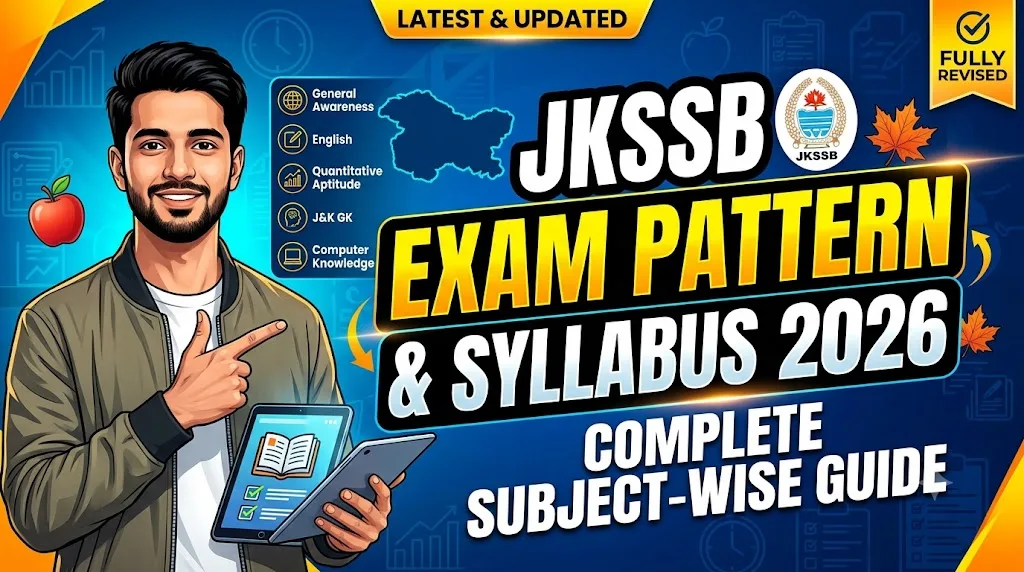
If you’re preparing for any post under the Jammu and Kashmir Services Selection Board, one thing becomes obvious very quickly — JKSSB exams don’t follow the same simple MCQ style you might be used to from other state-level recruitment boards. The questions are framed differently, the source material is narrower than most candidates expect, and the marking scheme punishes guesswork.
This guide breaks down the JKSSB exam pattern and syllabus for 2026 in plain language, post by post, so you know exactly what to study and how the paper will actually test you. We’ve also included where to find genuinely useful current affairs and free practice tests, since that’s usually the part candidates struggle with the most.
Understanding the JKSSB Exam Pattern in 2026
Before getting into subject lists, it helps to understand the shape of a JKSSB paper. Across almost every post — Junior Assistant, Sub Inspector, Junior Engineer, Teacher, Class IV, and others — the board follows a fairly consistent structure:
- The exam is conducted offline, as a pen-and-paper test at designated centres
- Questions are Objective Type (MCQ), generally with four options
- Negative marking applies, though the deduction amount differs by post
- The paper is divided into clearly defined sections, each carrying its own weight
Negative Marking: The Detail Most Candidates Get Wrong
Negative marking is not uniform across all JKSSB recruitments, and this trips up a lot of aspirants who assume one fixed rule applies everywhere.
| Post Category | Negative Marking |
|---|---|
| Junior Assistant | 0.25 marks per wrong answer |
| Sub Inspector (Police/Telecom) | 0.50 marks per wrong answer |
| Junior Engineer (Civil/Electrical) | 0.25 marks per wrong answer |
| Teacher (General/Science-Maths) | 0.25 marks per wrong answer |
| Class IV | 0.25 marks per wrong answer |
The takeaway here is simple: for posts with 0.50 negative marking, blind guessing is far riskier. Only attempt a question if you can eliminate at least two of the four options with reasonable confidence.
Why JKSSB Questions Feel Different: The Statement-Based Format
This is the single most important thing to understand about JKSSB papers in 2026, and it’s the reason so many well-prepared candidates still underperform.
JKSSB rarely asks a question in the simple “What is X?” format. Instead, most questions — especially in General Awareness and Reasoning — are framed as statements, where you’re asked to judge which statement (or combination of statements) is correct. A typical question looks like this:
Consider the following statements regarding the Indus Valley Civilization:
- Statement I — describes a fact
- Statement II — describes a related fact
Which of the statements given above is/are correct?
This format demands a deeper, more precise understanding of a topic rather than surface-level recall. You can’t just remember a fact in isolation — you need to know it well enough to spot when a statement has been subtly altered or made partially incorrect. This is why rote memorization alone fails most JKSSB aspirants, while candidates who practice with statement-based mock tests tend to perform noticeably better.
Where JKSSB Questions Actually Come From
A common mistake is preparing from a dozen scattered sources. In reality, JKSSB’s content base is narrower and more predictable than candidates assume.
1. NCERT Textbooks Form the Core
The majority of static General Awareness, History, Geography, Polity, and Science questions trace back to NCERT textbooks from Class 6 through Class 12. This is true across nearly every JKSSB post. If you’ve thoroughly revised NCERT content for these subjects, you’ve already covered the backbone of the General Awareness section.
2. Current Affairs from Newspapers and News Apps
The dynamic portion of General Awareness draws from recent national and international events, with a clear tilt toward Jammu & Kashmir-specific developments — government schemes, appointments, local infrastructure projects, and UT-level policy news. Reading a reliable daily newspaper or a current affairs app consistently for the 4–6 months before your exam is far more useful than cramming a single compilation PDF the night before.
3. J&K-Specific General Knowledge
Almost every JKSSB syllabus explicitly mentions “General Awareness with special reference to J&K UT.” This includes the history, geography, culture, and administrative structure of Jammu and Kashmir specifically — not just generic Indian GK.
Subject-Wise Syllabus by Post
Junior Assistant
| Section | Key Topics |
|---|---|
| General English | Comprehension, editing/proofreading, jumbled sentences, narration, modals, articles, idioms, synonyms/antonyms, active-passive voice |
| General Awareness (J&K focus) | Current events, history, culture, geography, polity of J&K and India |
| Numerical & Reasoning Ability | Number series, analogies, coding-decoding, basic arithmetic, data interpretation |
| Basic Computer Knowledge | Computer fundamentals, hardware/software, MS Office, email and internet basics |
The Junior Assistant paper runs for 80 minutes, shorter than most other JKSSB exams, which makes time management especially important.
Sub Inspector (Police)
| Section | Key Topics |
|---|---|
| Reasoning & Mental Ability | Analogies, coding-decoding, number/alphabet series, classification, blood relations, syllogism, statement & conclusion, direction & distance |
| General Awareness & Current Affairs | History, culture, geography, economics, sports, science, people in the news |
| Numerical Aptitude | Arithmetic, percentages, ratio-proportion, time-work-distance, mensuration |
| General English | Grammar, vocabulary, comprehension |
| Computer Knowledge | Basic computer operations and applications |
The SI exam runs for 120 minutes with 100 questions worth 200 marks, and carries the heavier 0.50 negative marking — accuracy matters more here than on most other JKSSB papers.
Junior Engineer (Civil / Electrical)
JE papers combine a general aptitude section with a technical, branch-specific section.
| Section | Key Topics |
|---|---|
| General Awareness & Reasoning | Standard GK and reasoning, similar to other posts |
| Technical (Civil) | Surveying, mechanics and structural analysis, construction planning and management, estimation and costing |
| Technical (Electrical) | Branch-specific core engineering subjects as per the official notification |
JE papers are conducted in English only and run for 120 minutes.
Teacher (General / Science-Maths)
| Section | Key Topics |
|---|---|
| General English | Grammar (degrees of comparison, tenses), comprehension |
| Analytical & Reasoning Ability | Analogies, coding-decoding, data sufficiency, arithmetical reasoning |
| General Awareness | History, culture, geography, current affairs |
| Subject-Specific Knowledge | Pedagogy and subject content depending on the teaching post applied for |
Class IV
| Section | Key Topics |
|---|---|
| Basic Mathematics | LCM/HCF, percentage, ratio-proportion, mensuration, time-work-distance |
| Basic Reasoning | Number series, analogies, odd-one-out, Venn diagrams |
| Basic English | Articles, prepositions, synonyms/antonyms, comprehension |
| General Awareness & Science | Elementary science and current GK |
Class IV papers are generally considered the most accessible among JKSSB exams in terms of difficulty level, though competition tends to be high due to the volume of applicants.
How to Structure Your Preparation
- Start with NCERT for History, Geography, Polity, and Science — this is non-negotiable groundwork for nearly every JKSSB post.
- Build a daily current affairs habit rather than relying on last-minute compilations. Even 20 minutes a day with a reliable news source adds up significantly over a few months.
- Practice statement-based MCQs specifically. Standard MCQ practice doesn’t train you for JKSSB’s actual question style — you need exposure to the statement-and-conclusion format to get comfortable with it.
- Take full-length mock tests under timed conditions. This is the only reliable way to gauge whether your speed and accuracy match what the exam demands.
- Revise J&K-specific content separately. Don’t let it get buried under general India-level GK, since J&K UT questions appear consistently across almost every JKSSB post.
Free Practice Resources
For candidates looking to practice the statement-based format specifically, Chinar Classes (chinarclasses.com) offers free and subscription-based mock tests modeled on the JKSSB pattern, along with subject-wise question banks and notes. The platform also has an Android app available on the Google Play Store for practicing on the go, which can be useful if you prefer revising during commutes or short breaks rather than sitting at a desk.
Key Takeaways
- JKSSB exams are objective-type, offline papers with negative marking that varies by post (typically 0.25, but 0.50 for Sub Inspector posts)
- The defining feature of JKSSB papers is the statement-based question format, which tests depth of understanding rather than simple recall
- NCERT textbooks form the core of static General Awareness content across nearly all posts
- Current affairs preparation should lean toward J&K-specific developments alongside national news
- Each post has its own section weightage and time duration, so always cross-check the specific notification for your post
- Regular, timed mock test practice is the most effective way to adapt to JKSSB’s distinctive question style
Conclusion
JKSSB exams reward candidates who understand how the board tests knowledge, not just how much knowledge they’ve accumulated. Once you internalize the statement-based format and build a steady NCERT-plus-current-affairs preparation routine, the syllabus itself becomes far less intimidating. Always verify exam dates, negative marking, and syllabus updates directly from the official JKSSB notification for your specific post, since these details can be revised between advertisements.
Frequently Asked Questions
1. Is the JKSSB exam pattern the same for every post?
No. While most posts share a similar objective-type, offline format, the number of sections, exam duration, and negative marking differ by post. Always check the specific advertisement notification.
2. What does “statement-based” mean in JKSSB questions?
It means a question presents one or more statements about a topic, and you must judge which statement(s) are factually correct, rather than answering a direct one-line question.
3. Is NCERT enough for JKSSB General Awareness?
NCERT covers most of the static portion well, but you’ll also need a separate current affairs source for recent events and J&K-specific developments not covered in textbooks.
4. How much is deducted for a wrong answer in JKSSB exams?
Most posts deduct 0.25 marks per wrong answer, but Sub Inspector posts deduct 0.50 marks, making accuracy more critical for that exam.
5. Are JKSSB admit cards available anywhere besides the official website?
No. Admit cards should only be downloaded from jkssb.nic.in. Third-party websites should never be relied upon for official documents.
Official Resources
- JKSSB Official Website — jkssb.nic.in
- Jammu and Kashmir Government Official Portal — jk.gov.in
- NCERT Official Website (for textbook downloads) — ncert.nic.in
- Press Information Bureau, J&K — pib.gov.in
- 📱 Download the Chinar Classes App:

Zahid Bhat is the founder of ExamzPrep. He has spent the last 4 years following JKSSB, SSC, Banking, Railway, UPSC, and State PSC recruitment cycles closely — tracking syllabus changes, question paper trends, and notification updates — and has qualified a JKSSB examination himself. ExamzPrep is built on that firsthand preparation experience: honest, free content for self-studying aspirants, with no courses to sell and no coaching to promote.