
The Jammu & Kashmir Public Service Commission (JKPSC) conducts the Combined Competitive Examination (CCE) every year to select officers for the Junior Scale of the J&K Administrative Service (KAS), J&K Police (Gazetted) Service, and J&K Accounts (Gazetted) Service. For thousands of graduates across the Union Territory, KAS remains the most coveted administrative career path, offering authority, stability and the chance to directly shape governance in Jammu and Kashmir.
But every year, only a small fraction of applicants actually clear the exam. The difference between those who succeed and those who don’t is rarely talent alone — it is strategy, consistency and the right approach to a three-stage selection process: Preliminary Examination, Main Examination and Personality Test (Interview).
This article lays out a practical, exam-focused study strategy for JKPSC KAS 2026 aspirants, whether you are a first-time candidate or someone re-attempting after a previous cycle.
Understanding the JKPSC KAS Exam Pattern First
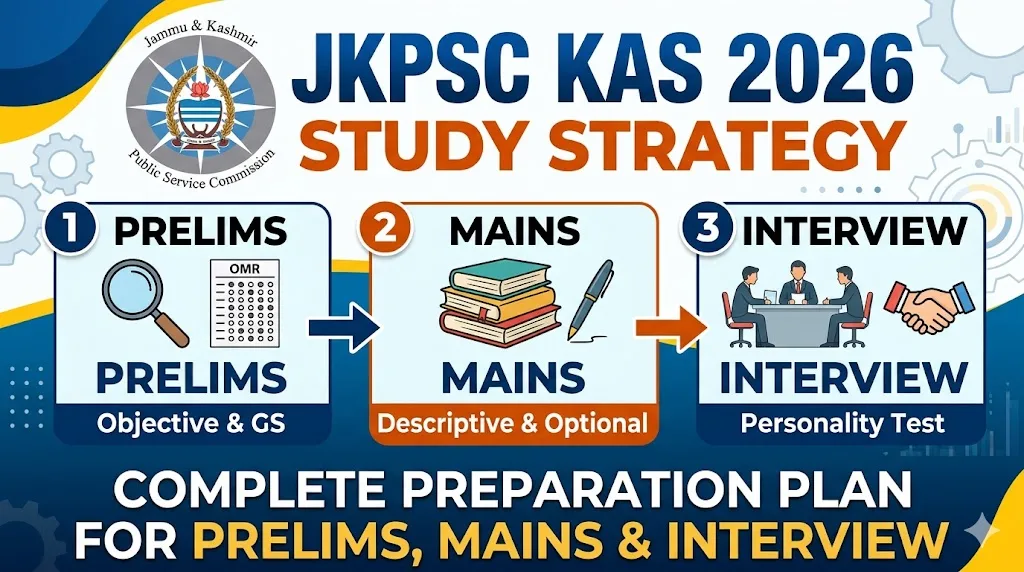
Before building a study plan, you need absolute clarity on what you are preparing for. JKPSC KAS selection happens in three stages:
- Preliminary Examination – An objective-type screening test, generally consisting of General Studies and a Civil Services Aptitude Test (CSAT)-style paper. This stage is qualifying in nature; marks are not added to the final merit.
- Main Examination – A descriptive, conventional-type examination comprising multiple General Studies papers, an Essay paper, a Language/Qualifying paper, and an Optional Subject of the candidate’s choice.
- Personality Test (Interview) – The final stage, assessing a candidate’s administrative aptitude, awareness, communication and suitability for public service.
Many aspirants make the mistake of preparing for prelims and mains as two separate, disconnected exams. The smarter approach is integrated preparation — since a large part of the GS syllabus overlaps between prelims and mains, studying with both stages in mind from day one saves months of revision later.
Step 1: Build a Strong Foundation with NCERTs and Static Syllabus
Regardless of how advanced your preparation is, the base layer of KAS preparation must be built on NCERT-level clarity in:
- History (Ancient, Medieval, Modern India, and J&K-specific history)
- Geography (Physical, Indian, and J&K geography)
- Polity and Governance (Indian Constitution, Panchayati Raj, J&K’s special administrative structure)
- Economy (Basic concepts, Indian economy, government schemes)
- General Science and Environment
J&K-specific content deserves special attention because it carries significant weightage in both prelims and mains. Topics like the history of Jammu and Kashmir, Dogra rule, the accession process, Article 370 and its abrogation, the Reorganisation Act, local administrative structures, and the region’s geography, demography and culture are frequently tested and often under-prepared by candidates who rely only on generic UPSC material.
A disciplined aspirant should complete this static foundation within the first three to four months, because the remaining time needs to go into current affairs, answer writing and revision — not first-time reading.
Step 2: Treat Current Affairs as a Daily Habit, Not a Last-Minute Sprint
Current affairs is the single biggest differentiator in any state PSC exam, and JKPSC KAS is no exception. The questions are rarely generic; they are often tied to government schemes, policy changes, infrastructure projects, and developments specific to Jammu and Kashmir.
A reliable current affairs strategy looks like this:
- Read one standard newspaper daily (editorial + national/state news), spending no more than 45–60 minutes
- Maintain monthly compiled notes rather than scattered daily notes that are hard to revise
- Specifically track J&K government notifications, budget announcements, new policies, and Lieutenant Governor’s initiatives
- Revise current affairs every weekend in summary form, not as fresh reading
Static and current affairs should never be studied in isolation. For example, when reading about a new irrigation project in J&K, simultaneously revise the geography of that region. This linking technique dramatically improves retention and answer quality in mains.
Step 3: Prioritise Answer Writing from the Beginning, Not After Prelims
One of the most common and costly mistakes KAS aspirants make is starting answer writing practice only after the prelims result is declared. By then, candidates typically have just 6–8 weeks before mains — not nearly enough time to develop a structured, examiner-friendly writing style.
Instead, begin answer writing practice alongside your foundational studies. Even two to three answers a day, focused on structure (introduction, body with subheadings, conclusion) and word-limit discipline, will compound into a significant advantage by the time mains approaches.
Key habits to develop:
- Stick strictly to word limits; examiners penalise both under- and over-writing
- Use the introduction to define the question’s scope, not just restate it
- Support arguments with examples, data, or government scheme references wherever relevant
- Write a crisp, forward-looking conclusion, especially for governance and ethics-style questions
- Get answers evaluated by a mentor, senior, or peer group periodically
Step 4: Choose Your Optional Subject Strategically
The optional subject carries substantial weight in the mains examination, yet many candidates choose it based on what is “trending” rather than what suits them. Before finalising an optional, evaluate it against three criteria:
- Background advantage – Does your graduation/post-graduation background give you a head start?
- Syllabus overlap with GS – Subjects like Geography, Public Administration, History and Economics overlap meaningfully with the General Studies papers, reducing total preparation load.
- Availability of quality study material and past-year trend – Choose a subject for which standard books, notes and previous papers are easily accessible.
Once chosen, avoid switching optionals midway through preparation — subject-switching is one of the most common reasons serious aspirants lose an entire preparation cycle.
Step 5: Practice Smart for the CSAT/Aptitude Paper
While CSAT is qualifying in nature, underestimating it has cost many otherwise well-prepared candidates a shot at mains. Dedicate at least three to four hours a week to:
- Quantitative aptitude basics (percentages, ratios, time-speed-distance, data interpretation)
- Logical reasoning and analytical ability
- Reading comprehension, practised under timed conditions
Since the qualifying cut-off is generally moderate, the goal here is consistency and speed, not mastery — don’t let CSAT preparation eat into core GS study time disproportionately.
Step 6: Design a Realistic Daily and Weekly Timetable
A study plan only works if it survives contact with daily life. A practical structure many successful candidates follow:
- Morning (2–3 hours): Static subject study (rotate History, Geography, Polity, Economy)
- Afternoon/Evening (1–1.5 hours): Current affairs reading and note-making
- Evening (1 hour): Answer writing or MCQ practice
- Weekly: One full revision day, one mock test (prelims or mains-style based on your stage)
The exact hours matter less than the consistency. A focused six hours a day, six days a week, sustained over months, will consistently outperform sporadic ten-hour days followed by burnout.
Step 7: Make Mock Tests and Revision Non-Negotiable
Mock tests serve two purposes: they reveal knowledge gaps, and they build exam-day temperament — managing time pressure, negative marking anxiety, and fatigue. Starting at least three to four months before prelims, take a full-length mock weekly, followed by detailed error analysis. Don’t just check the score; categorise every wrong answer as a knowledge gap, a silly mistake, or a guessing error, and address each differently.
For mains, simulate writing conditions: a three-hour paper, no extra reference material, strict word limits. This builds the writing stamina that pure reading can never develop.
Step 8: Prepare Early for the Personality Test
The interview stage is often neglected until results are out, leaving candidates with limited preparation time. Begin early by:
- Preparing a clear, honest narrative around your academic background, work experience (if any), and reasons for choosing civil services
- Staying updated on current affairs related to J&K administration, government schemes, and recent policy developments
- Practising mock interviews to build composure and clarity of expression
- Reviewing your Detailed Application Form (DAF) thoroughly, since most questions originate from it
Common Mistakes KAS Aspirants Should Avoid
- Relying solely on generic UPSC material without supplementing it with J&K-specific content
- Hoarding too many books and sources instead of revising fewer sources multiple times
- Ignoring answer writing until after the prelims result
- Studying current affairs without linking it to static portions
- Neglecting the optional subject until the final months before mains
Final Thoughts
JKPSC KAS 2026 preparation is less about working harder than everyone else and more about working with a clear, structured strategy sustained over months. Strong fundamentals, daily current affairs discipline, early and consistent answer writing, a well-chosen optional subject, and regular mock testing form the backbone of a winning approach. Aspirants who treat this as a marathon rather than a sprint — building steady habits instead of chasing last-minute shortcuts — give themselves the strongest chance of converting their KAS attempt into a selection.
Stay consistent, track your progress honestly, and revise relentlessly. That combination, more than any single resource or shortcut, is what ultimately separates a successful KAS candidate from the rest.

Zahid Bhat is the founder of ExamzPrep. He has spent the last 4 years following JKSSB, SSC, Banking, Railway, UPSC, and State PSC recruitment cycles closely — tracking syllabus changes, question paper trends, and notification updates — and has qualified a JKSSB examination himself. ExamzPrep is built on that firsthand preparation experience: honest, free content for self-studying aspirants, with no courses to sell and no coaching to promote.