
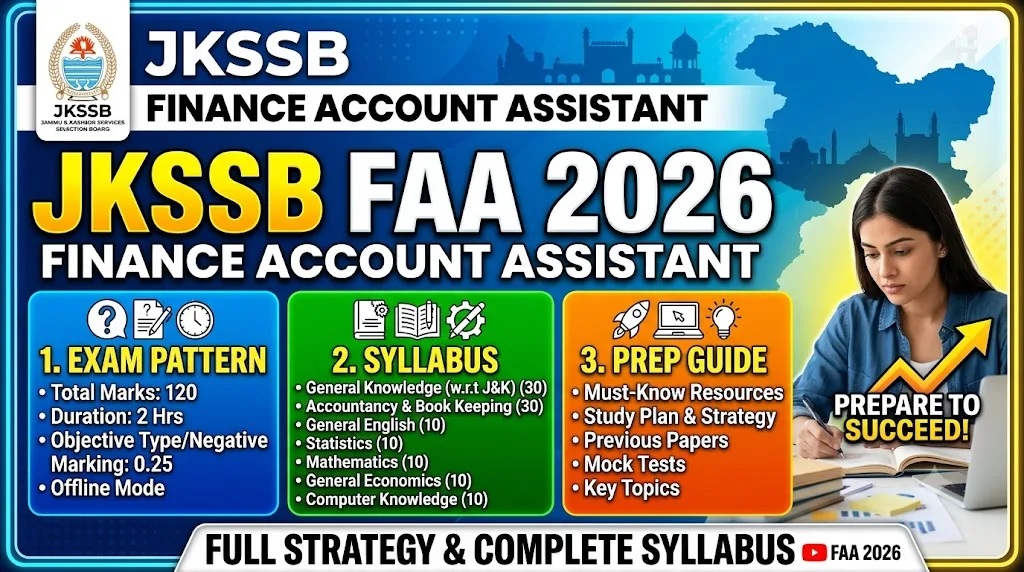
If you have applied for the Finance Accounts Assistant post under the Jammu and Kashmir Services Selection Board, you are probably looking for one thing right now: a clear, no-nonsense understanding of the exam pattern and syllabus. With 600 vacancies up for grabs in the Finance Department, this is one of the largest and most closely watched recruitment drives JKSSB has run in recent years, and competition is expected to be intense.
The good news is that JKSSB has already released the official syllabus for this post, commonly referred to as JKSSB FAA (Finance Accounts Assistant). This article breaks down everything you need to know — the exam structure, subject-wise weightage, marking scheme, and a realistic preparation roadmap — using information drawn from the official syllabus document and verified recruitment notifications.
We will keep things simple and practical here. No exaggerated claims, no guesswork dressed up as fact. Just a clear picture of what the JKSSB FAA exam looks like and how you can prepare for it sensibly.
What Is the JKSSB Finance Accounts Assistant Post
The Finance Accounts Assistant post falls under the Finance Department of the Jammu and Kashmir Union Territory administration. This recruitment was advertised with a total of 600 posts, making it one of the bigger drives in the current JKSSB cycle.
Applications for this post were accepted online, with the application window closing on 6th January 2026. Since the application process is already over, candidates who applied should now be focused entirely on exam preparation rather than eligibility queries.
Why This Post Attracts So Many Aspirants
Finance and accounts roles in government departments are popular for a simple reason: they offer long-term stability, a structured pay scale, and a clear career path within the administrative system. For commerce and finance graduates in Jammu and Kashmir, the FAA post is often seen as a strong entry point into government service.
JKSSB FAA Exam Pattern: The Basics
Understanding the exam pattern before you start studying is just as important as knowing the syllabus itself. It tells you how your time and effort should be distributed across subjects.
Based on the official syllabus notification, here is the exam structure for the JKSSB FAA written test:
| Exam Detail | Information |
|---|---|
| Mode of Exam | Offline, OMR-based objective test |
| Question Type | Multiple Choice Questions (MCQs) |
| Total Questions | 120 |
| Total Marks | 120 |
| Duration | 2 hours (120 minutes) |
| Negative Marking | 0.25 marks deducted per wrong answer |
| Selection Stages | Written Exam followed by Document Verification |
There is no interview stage in this recruitment, which means your written exam performance is the single most important factor in your selection.
Why the Negative Marking Rule Matters
A 0.25 negative marking rule might sound minor, but across 120 questions, it can significantly affect your final score if you guess carelessly. For example, if you attempt 100 questions and get 60 right and 40 wrong, you lose 10 marks just from incorrect guesses. This is why accuracy should be your priority over attempting every single question blindly.
Subject-Wise Syllabus Breakdown
The JKSSB FAA syllabus covers a wide range of subjects, blending general aptitude topics with specialized accounting and finance knowledge. Here is a breakdown of the major sections you need to prepare.
1. General Knowledge with Special Reference to J&K
This section tests your awareness of current affairs along with a strong regional focus on Jammu and Kashmir. Important areas include:
- Current events of national and international importance
- Political and physical divisions of India and the world
- Indian culture, heritage, and the freedom struggle
- J&K’s history, economy, geography, and culture
- The J&K Reorganisation Act, 2019, and related administrative changes
- Important rivers, lakes, and tourist destinations of J&K
2. Accountancy and Book Keeping
This is the core technical section and carries significant weight in the exam. Topics typically include:
- Introduction to financial accounting and basic terminology
- Journal entries, ledger posting, and trial balance
- Bank Reconciliation Statements (BRS)
- Depreciation methods and final accounts preparation
- Vouchers, subsidiary books, and rectification of errors
3. General English
This section checks your command over grammar, vocabulary, and comprehension. Expect questions on:
- Sentence correction and error detection
- Synonyms, antonyms, and one-word substitutions
- Reading comprehension passages
- Basic grammar rules and usage
4. Mathematics and Statistics
A mix of basic arithmetic and applied statistics, including:
- Percentages, ratios, averages, and profit-loss calculations
- Simple and compound interest
- Time, speed, and work-related problems
- Measures of central tendency and basic data interpretation
5. General Economics
This section introduces fundamental economic concepts relevant to public administration, such as:
- Basic principles of demand and supply
- National income and economic planning concepts
- Government budgeting basics
- Economic terms relevant to public finance
6. General Science
A standard science section covering:
- Basic physics, chemistry, and biology concepts
- Everyday scientific phenomena
- Environment, ecology, and biodiversity basics
7. Knowledge of Computers
Given that most government accounting work today happens digitally, this section covers:
- Basic computer hardware and software concepts
- MS Office applications, especially Excel
- Internet basics and digital communication tools
- General awareness of government digital platforms used in finance, such as PFMS
Subject-Wise Weightage Overview
While JKSSB has not published an exact marks-per-subject breakdown publicly, based on the structure of the syllabus and the nature of the post, candidates can expect Accountancy and General Knowledge to carry the highest weight. Here is a general preparation-focused estimate to help you allocate your study time, rather than an official marks distribution:
| Subject Area | Relative Preparation Priority |
|---|---|
| Accountancy & Book Keeping | High |
| General Knowledge (J&K focus) | High |
| Mathematics & Statistics | Medium |
| General English | Medium |
| Computer Knowledge | Medium |
| General Economics | Medium |
| General Science | Low to Medium |
This table is meant only as a study-planning guide. Always refer to the official syllabus PDF on jkssb.nic.in for the authoritative subject list.
How to Prepare for the JKSSB FAA Exam
Preparing for an exam with 120 questions across seven to eight subject areas can feel overwhelming if you don’t have a structured plan. Here is a practical approach that works well for multi-subject government exams like this one.
Step 1: Start with the Official Syllabus
Before picking up any book or joining any course, read the official syllabus PDF carefully. This helps you understand exactly which topics are included and which are not, so you don’t waste time studying irrelevant material.
Step 2: Prioritize High-Weight Subjects First
Since Accountancy and General Knowledge tend to carry more questions in exams of this nature, build a strong foundation in these areas first. For accountancy specifically, focus on practical problem-solving rather than just theory — practice journal entries and reconciliation statements until they become second nature.
Step 3: Build a Daily Current Affairs Habit
General Knowledge sections in JKSSB exams often lean heavily on regional J&K content. Reading a regional newspaper daily and noting down important developments, especially related to government schemes, infrastructure projects, and administrative changes in J&K, can give you a real edge.
Step 4: Practice Previous Year Papers
Even if exact previous-year papers for this specific post are limited, practicing papers from similar JKSSB administrative or accounts-related exams can help you get used to the question style and time pressure.
Step 5: Take Timed Mock Tests
With a 2-hour limit for 120 questions, you have roughly one minute per question. Practicing under timed conditions helps you build the speed and accuracy balance needed to avoid losing marks to negative marking.
Step 6: Revise in Cycles, Not Once
Instead of studying a topic once and moving on, revisit each subject in cycles. Short, repeated revision sessions tend to retain information far better than one long study session.
Common Mistakes Candidates Should Avoid
- Ignoring the negative marking rule: Guessing randomly on questions you are unsure about can hurt your score more than leaving them unattempted.
- Overlooking regional GK: Many candidates focus only on national-level current affairs and miss out on J&K-specific questions, which often form a meaningful portion of the GK section.
- Treating accountancy as purely theoretical: This section rewards practical problem-solving skills, so passive reading without practice rarely helps.
- Skipping computer knowledge preparation: Since this section is often considered “easy,” candidates sometimes under-prepare for it and lose easy marks.
- Relying only on unofficial sources: Always cross-check syllabus details and exam dates from the official JKSSB website rather than depending solely on coaching institute claims.
Key Takeaways
- The JKSSB FAA recruitment covers 600 posts under the Finance Department, with the online application window having closed on 6th January 2026.
- The written exam consists of 120 objective questions worth 120 marks, to be completed in 2 hours.
- A negative marking of 0.25 marks applies for every wrong answer, making accuracy essential.
- The syllabus spans General Knowledge (J&K focus), Accountancy and Book Keeping, English, Mathematics, Statistics, Economics, Science, and Computer Knowledge.
- Selection is based on the written exam followed by document verification, with no interview stage.
- A focused, cycle-based revision strategy combined with regular mock tests is the most reliable way to prepare for this exam.
Conclusion
The JKSSB Finance Accounts Assistant exam is a significant opportunity for finance and commerce aspirants in Jammu and Kashmir, but it demands disciplined preparation across a genuinely broad syllabus. Understanding the exam pattern clearly, prioritizing high-weight subjects like Accountancy and General Knowledge, and respecting the negative marking rule can make a real difference to your final score.
As the exam date approaches, candidates should regularly check the official JKSSB website for updates on admit cards, exam centers, and any changes to the schedule. Preparation built on official information, combined with consistent practice, remains the most dependable path to success in this exam.
Frequently Asked Questions
1. How many questions are there in the JKSSB FAA exam, and how much time is given?
The exam consists of 120 multiple-choice questions worth 120 marks, and candidates are given 2 hours to complete it.
2. Is there a negative marking scheme in the JKSSB FAA exam?
Yes, 0.25 marks are deducted for every incorrect answer, so candidates should attempt questions carefully rather than guessing randomly.
3. Does the JKSSB FAA selection process include an interview?
No. As per the current recruitment structure, selection is based on the written examination followed by document verification, with no interview stage involved.
4. Which subjects carry the most weight in the JKSSB FAA syllabus?
While JKSSB has not released an exact marks-per-subject breakdown, Accountancy and Book Keeping along with General Knowledge focused on J&K are generally considered high-priority areas based on the syllabus structure.
5. Where can candidates download the official JKSSB FAA syllabus PDF?
The official syllabus PDF is available on the JKSSB website, jkssb.nic.in, under the syllabus or notifications section for the Finance Accounts Assistant post.
Official Resources
- Jammu and Kashmir Services Selection Board (JKSSB) – Official Website
- JKSSB Syllabus Page
- JKSSB Finance Accounts Assistant Syllabus PDF
- Finance Department, Government of Jammu and Kashmir
- JKSSB Notifications Page

Zahid Bhat is the founder of ExamzPrep. He has spent the last 4 years following JKSSB, SSC, Banking, Railway, UPSC, and State PSC recruitment cycles closely — tracking syllabus changes, question paper trends, and notification updates — and has qualified a JKSSB examination himself. ExamzPrep is built on that firsthand preparation experience: honest, free content for self-studying aspirants, with no courses to sell and no coaching to promote.