
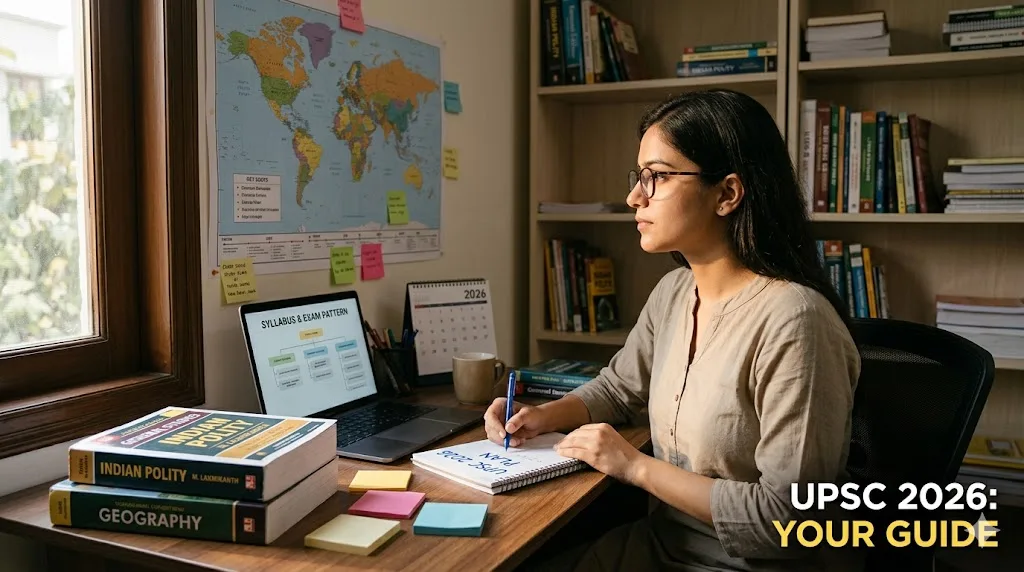
The UPSC Civil Services Examination is the most prestigious competitive exam in India. It selects candidates for the Indian Administrative Service (IAS), Indian Police Service (IPS), Indian Foreign Service (IFS), and over 20 other Group A and Group B central services. Every year approximately 10–11 lakh candidates register, around 5–6 lakh appear, and roughly 1,000 are finally selected.
This guide is for aspirants who are beginning their UPSC journey or want a clear, honest picture of what the exam involves — the complete syllabus, the three-stage structure, eligibility, and how to approach preparation realistically.
UPSC CSE 2026 — Overview
| Detail | Information |
|---|---|
| Conducting Body | Union Public Service Commission (UPSC) |
| Exam Name | Civil Services Examination (CSE) |
| Services | IAS, IPS, IFS, IRS, and 20+ other services |
| Vacancies | Approximately 1,000 per year (varies) |
| Qualification | Graduation from any recognised university |
| Age Limit | 21–32 years (General) |
| Attempts | 6 attempts (General), 9 (OBC), unlimited until age limit (SC/ST) |
| Official Website | upsc.gov.in |
The Three Stages
UPSC CSE has three distinct stages — each eliminates a large portion of candidates.
Stage 1 — Preliminary Examination (Prelims)
Two papers, both objective MCQ:
Paper 1 — General Studies (200 marks, 2 hours)
| Subject | Approximate Weightage |
|---|---|
| Current events (national and international) | 20–25% |
| Indian History and National Movement | 15–20% |
| Indian and World Geography | 15% |
| Indian Polity and Governance | 15–20% |
| Economic and Social Development | 10% |
| Environment and Ecology | 10–12% |
| General Science | 8–10% |
- 100 questions, 200 marks
- Negative marking: 0.66 marks per wrong answer
- Only Paper 1 marks count for Prelims cutoff
Paper 2 — CSAT (200 marks, 2 hours)
- Comprehension
- Interpersonal skills including communication skills
- Logical reasoning and analytical ability
- Decision making and problem solving
- General mental ability
- Basic numeracy (Class 10 level)
- Qualifying paper — minimum 33% required, marks do not count in merit
Approximately 12–15 times the number of Mains vacancies are shortlisted from Prelims.
Stage 2 — Main Examination (Mains)
Nine papers — only 7 count for merit:
| Paper | Subject | Marks |
|---|---|---|
| Paper A | Indian Language (qualifying) | 300 |
| Paper B | English (qualifying) | 300 |
| Paper 1 | Essay | 250 |
| Paper 2 | General Studies 1 | 250 |
| Paper 3 | General Studies 2 | 250 |
| Paper 4 | General Studies 3 | 250 |
| Paper 5 | General Studies 4 (Ethics) | 250 |
| Paper 6 | Optional Subject Paper 1 | 250 |
| Paper 7 | Optional Subject Paper 2 | 250 |
| Total (merit papers) | 1750 |
All papers are descriptive — written answers, not MCQ.
Stage 3 — Personality Test (Interview)
- 275 marks
- Conducted by a UPSC board
- Tests personality, suitability for civil service, and analytical thinking
- Final merit: Mains (1750) + Interview (275) = 2025 marks total
Complete Mains Syllabus
General Studies Paper 1 — Indian Heritage, Culture, History, Geography
- Indian culture — art forms, literature, architecture
- Modern Indian history (1857 onwards) — significant events, personalities, issues
- Freedom struggle — various stages and contributors
- Post-independence consolidation
- World history — 18th century to present (industrial revolution, world wars, colonialism, cold war)
- Indian society — diversity, role of women, poverty, population
- Urbanisation, social empowerment
- Physical geography — earthquakes, volcanoes, cyclones, ocean currents
- Distribution of key natural resources
- Indian geography — physical, social, economic
- World geography
General Studies Paper 2 — Governance, Constitution, Polity, International Relations
- Indian Constitution — features, amendments, significant provisions
- Parliament and state legislatures
- Structure, organisation, functioning of executive and judiciary
- Government ministries and departments
- Pressure groups and formal/informal associations
- Statutory, regulatory and quasi-judicial bodies
- Government policies and interventions
- Development processes and NGO role
- Welfare schemes for vulnerable sections
- Issues relating to poverty, hunger, health, education
- Governance, transparency, accountability
- Role of civil services in democracy
- India and its neighbourhood
- Bilateral, regional, global groupings
- India’s foreign policy
- International organisations — UN, WHO, WTO, IMF, World Bank
General Studies Paper 3 — Technology, Economy, Environment, Security
- Indian economy — planning, mobilisation of resources
- Inclusive growth
- Government budgeting
- Agriculture — issues and related constraints
- Food processing and related industries
- Land reforms
- Effects of liberalisation on economy
- Industrial policy, infrastructure
- Investment models
- Science and technology — developments and applications
- Achievements of Indians in science and technology
- Awareness of IT, space, computers, robotics, nano-technology, bio-technology
- Environmental conservation, pollution, climate change
- Disaster management
- Linkages between development and spread of extremism
- Internal security challenges
- Security forces and agencies
General Studies Paper 4 — Ethics, Integrity, Aptitude
- Ethics and human interface
- Determinants and consequences of ethics in human actions
- Dimensions of ethics
- Ethics in private and public relationships
- Human values
- Role of family, society, educational institutions in inculcating values
- Attitude — content, structure, function
- Moral and political attitudes
- Social influence and persuasion
- Aptitude and foundational values for civil service
- Integrity, impartiality, non-partisanship, objectivity
- Tolerance and compassion
- Emotional intelligence — concepts, utilities
- Contributions of moral thinkers and philosophers
- Public/civil service values and ethics
- Probity in governance
- Philosophical basis of governance and integrity
- Information sharing and transparency
- Codes of ethics and conduct
- Citizen’s charter, work culture, quality of service delivery
- Case studies on ethics
Essay Paper
Two essays — one from each of two sections. 1000–1200 words each. Topics can be philosophical, social, economic, or abstract. This paper is where many serious candidates lose significant marks due to underpreparation.
Optional Subject
Candidates choose one optional subject with two papers (250 marks each = 500 marks total). The optional subject can make or break your rank.
Popular optional subjects:
- Public Administration
- Sociology
- Geography
- History
- Political Science & International Relations
- Anthropology
- Psychology
- Economics
- Hindi Literature / Urdu Literature
- Law
How to choose your optional: Choose based on your genuine interest and background — not based on what is “scoring” or what your coaching centre pushes. A subject you find interesting is one you will study more deeply and write better answers on.
Eligibility
Educational Qualification: Graduation in any subject from any recognised university. Final year students can also appear (subject to producing degree proof at Mains stage).
Age Limit:
| Category | Upper Age Limit | Attempts |
|---|---|---|
| General | 32 years | 6 |
| OBC | 35 years | 9 |
| SC/ST | 37 years | Unlimited |
| PwD (General) | 42 years | 9 |
| PwD (OBC) | 45 years | 9 |
| PwD (SC/ST) | 47 years | Unlimited |
| Ex-Servicemen | 37 years | As per rules |
Realistic Preparation Timeline
For a serious first-attempt candidate starting from scratch:
Months 1–4 (Foundation): Read all NCERT books for History (6–12), Geography (6–12), Political Science (9–12), Economics (9–12), and Science (6–10). Read The Hindu or Indian Express daily. Build conceptual foundation — do not attempt mock tests yet.
Months 5–8 (Standard References): Laxmikanth for Polity. Ramesh Singh for Economy. Spectrum for Modern History. Bipin Chandra for Freedom Struggle. Start optional subject preparation in parallel. Begin answer writing practice — one answer per day minimum.
Months 9–12 (Prelims Focus): Solve previous year Prelims papers. Start taking full-length Prelims mock tests. Continue daily newspaper reading. Revise standard references. Current affairs consolidation.
After Prelims — Mains Preparation (4–5 months): Intensive answer writing. Essay practice weekly. Optional subject completion. Ethics case studies. Current affairs integration into GS answers.
The Honest Reality
UPSC preparation takes 12–18 months minimum for a serious first attempt. Many candidates take 2–3 attempts. The exam is not impossibly hard — it rewards consistent, disciplined preparation over a long period more than it rewards brilliance.
The single most common reason candidates fail despite years of preparation: they read extensively but do not practice writing answers. Mains is a written exam. Writing practice is non-negotiable.
Official Links
- UPSC Official Website: upsc.gov.in
- UPSC Syllabus PDF: Available at upsc.gov.in → Examinations → Civil Services Examination → Syllabus
- Previous Year Papers: Available at upsc.gov.in → Examinations → Previous Question Papers
Published by ExamzPrep — free government exam preparation for serious aspirants. Last updated May 2026.

Zahid Bhat is the founder of ExamzPrep. He has spent the last 4 years following JKSSB, SSC, Banking, Railway, UPSC, and State PSC recruitment cycles closely — tracking syllabus changes, question paper trends, and notification updates — and has qualified a JKSSB examination himself. ExamzPrep is built on that firsthand preparation experience: honest, free content for self-studying aspirants, with no courses to sell and no coaching to promote.