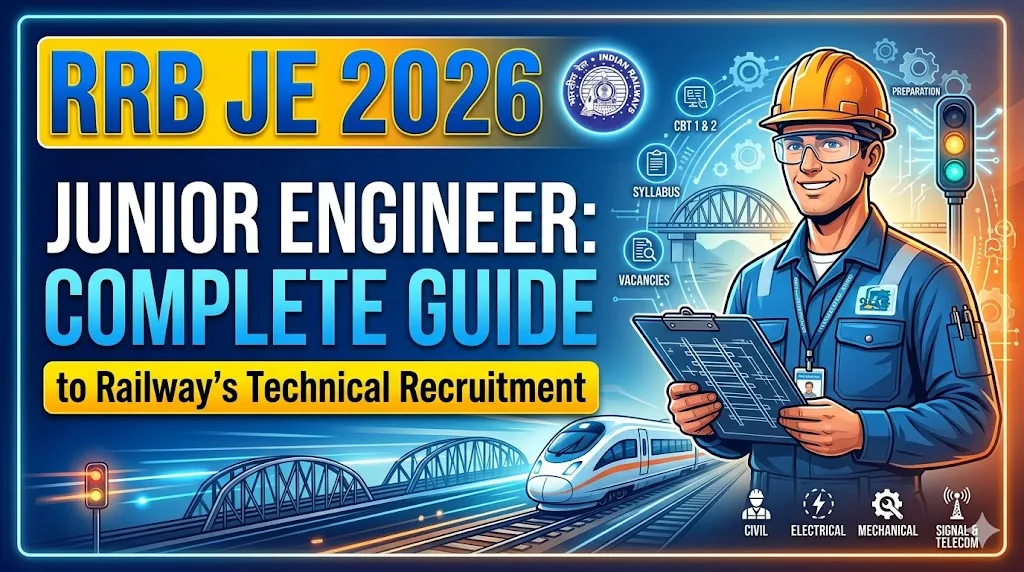
The Railway Recruitment Board Junior Engineer (RRB JE) examination recruits technical staff for Indian Railways across six engineering departments — Civil, Electrical, Mechanical, Electronics & Communication, Information Technology, and Depot Material Superintendent. It is the most technical of all RRB exams and requires subject-specific engineering knowledge beyond general aptitude.
JE posts are Level 6 positions (₹35,400–₹1,12,400) — the same pay level as SSC CPO Sub-Inspector and RPF Sub-Inspector, but with an engineering background requirement and a completely different work profile. Railway JEs maintain and operate railway infrastructure — from tracks and bridges to electrical systems, signalling equipment, and rolling stock.
RRB JE 2026 — Overview
| Detail | Information |
|---|---|
| Conducting Body | Railway Recruitment Boards (RRBs) |
| Post | Junior Engineer (JE) and Junior Engineer (Information Technology) |
| Pay Level | Level 6 (₹35,400–₹1,12,400) |
| Qualification | Diploma in Engineering (3-year) or Degree in Engineering/Technology |
| Age Limit | 18–36 years (General) |
| Selection | CBT 1 → CBT 2 → Document Verification → Medical |
| Official Website | indianrailways.gov.in / RRB websites |
Posts Available Under RRB JE
| Post | Department | Engineering Background Required |
|---|---|---|
| Junior Engineer (Civil) | Civil Engineering | Civil Engineering Diploma/Degree |
| Junior Engineer (Electrical) | Electrical Engineering | Electrical Engineering Diploma/Degree |
| Junior Engineer (Mechanical) | Mechanical Engineering | Mechanical Engineering Diploma/Degree |
| Junior Engineer (Signal) | Signal & Telecommunication | ECE / Electrical Diploma/Degree |
| Junior Engineer (Telecommunication) | S&T Department | ECE / Telecom Diploma/Degree |
| Junior Engineer (IT) | Information Technology | Computer Science / IT Diploma/Degree |
| Depot Material Superintendent (DMS) | Stores Department | Any Engineering Diploma/Degree |
| Chemical & Metallurgical Assistant (CMA) | Metallurgy/Chemistry | Chemical/Metallurgical Engineering |
RRB JE 2026 Exam Pattern
Stage 1 — CBT 1
| Subject | Questions | Marks | Time |
|---|---|---|---|
| Mathematics | 30 | 30 | |
| General Intelligence & Reasoning | 25 | 25 | |
| General Awareness | 15 | 15 | |
| General Science | 30 | 30 | |
| Total | 100 | 100 | 90 minutes |
- Negative marking: 1/3 per wrong answer
- Qualifying — shortlists for CBT 2
Stage 2 — CBT 2
| Subject | Questions | Marks | Time |
|---|---|---|---|
| General Awareness | 15 | 15 | |
| Physics & Chemistry | 15 | 15 | |
| Basics of Computers & Applications | 10 | 10 | |
| Basics of Environment & Pollution Control | 10 | 10 | |
| Technical Abilities (Engineering subject) | 100 | 100 | |
| Total | 150 | 150 | 120 minutes |
- Negative marking: 1/3 per wrong answer
- Technical Abilities (100 marks) is the core of CBT 2 — questions from your specific engineering branch
Syllabus — General Subjects (CBT 1 + CBT 2)
Mathematics
- Number systems and BODMAS
- Fractions and percentages
- LCM and HCF
- Ratio and proportion
- Simple and compound interest
- Profit and loss
- Time and work, time and distance
- Geometry — triangles, circles
- Mensuration — area, volume
- Trigonometry
- Elementary statistics
- Square roots and indices
General Intelligence & Reasoning
- Analogies, classification, series
- Coding and decoding
- Mathematical operations
- Relationships
- Syllogisms
- Venn diagrams
- Data interpretation
- Conclusions and decision making
- Similarities and differences
- Analytical and spatial reasoning
General Science (CBT 1 — 30 marks)
Physics, Chemistry, and Life Sciences at Class 10 level — same as other RRB exams.
Physics & Chemistry (CBT 2 — 15 marks)
Slightly higher level than CBT 1 General Science:
- Measurements and units
- Mechanics — force, motion, work, energy
- Heat, light, sound properties
- Electricity and magnetism
- Atomic structure, chemical bonding
- Chemical reactions, acids/bases/salts
- Environmental chemistry
Basics of Computers & Applications
- Computer fundamentals — hardware, software
- Input/output devices
- MS Office basics
- Internet and networking
- Operating systems
- Database basics
Basics of Environment & Pollution Control
- Environmental pollution — air, water, soil, noise
- Causes and effects of different types of pollution
- Pollution control measures
- Green initiatives and renewable energy
- Environmental legislation basics
Technical Abilities Syllabus — By Branch
Civil Engineering (100 marks)
- Engineering Mechanics — forces, equilibrium, trusses
- Strength of Materials — stress, strain, beam bending, columns
- Structural Analysis — beams, frames
- RCC Design — flexure, shear, bond
- Steel Design — tension, compression members
- Soil Mechanics — properties, permeability, consolidation, bearing capacity
- Foundation Engineering — types of foundations
- Fluid Mechanics — properties of fluids, flow equations, pipes
- Hydraulic Machines — pumps, turbines
- Irrigation Engineering — canal design, water logging
- Transportation Engineering — highway design, railway engineering
- Environmental Engineering — water supply, sewage treatment
- Surveying — chain, compass, levelling, total station
Electrical Engineering (100 marks)
- Basic Electrical Concepts — Ohm’s law, Kirchhoff’s laws, circuit analysis
- AC Circuits — phasors, power factor, resonance
- Electrical Machines — DC motors and generators, transformers, induction motors, synchronous machines
- Power Systems — transmission lines, substations, protection
- Control Systems — transfer function, Bode plot, stability
- Electrical Measurements — instruments, errors
- Power Electronics — diodes, thyristors, converters
- Installation and Wiring — wiring systems, earthing
- Renewable Energy — solar, wind basics
Mechanical Engineering (100 marks)
- Engineering Mechanics — statics, dynamics
- Strength of Materials
- Theory of Machines — kinematics, dynamics, governors
- Machine Design — shafts, keys, bearings, gears
- Fluid Mechanics and Machinery — pumps, turbines
- Thermodynamics — laws, cycles, steam tables
- Heat Transfer — conduction, convection, radiation
- Manufacturing Technology — casting, welding, machining
- Production Engineering — metrology, quality control
- Refrigeration and Air Conditioning
- Automobile Engineering basics
Electronics & Communication Engineering (100 marks)
- Network Theory — circuit analysis, theorems
- Electronic Devices — diodes, transistors, FETs
- Analog Circuits — amplifiers, op-amps, oscillators
- Digital Electronics — logic gates, flip-flops, counters, ADC/DAC
- Signals and Systems — Fourier transform, Laplace transform
- Communication Systems — AM, FM, digital modulation
- Microprocessors — 8085/8086 architecture and programming
- Control Systems
- Electromagnetic Theory
- Antennas and Wave Propagation
Computer Science / IT (100 marks)
- Programming — C, C++, Java basics
- Data Structures — arrays, linked lists, trees, graphs
- Algorithms — sorting, searching, complexity
- Operating Systems — process management, memory management, file systems
- Database Management Systems — SQL, normalisation, transactions
- Computer Networks — OSI model, TCP/IP, protocols
- Web Technologies — HTML, HTTP, basics of web development
- Software Engineering — SDLC, testing
- Computer Organisation and Architecture
Eligibility
Qualification: 3-year Diploma in Engineering in relevant branch, OR 4-year Engineering Degree (B.E./B.Tech) in relevant branch, from a recognised institution.
Age Limit:
| Category | Age Limit |
|---|---|
| General | 18–36 years |
| OBC | 18–39 years |
| SC/ST | 18–41 years |
| PwD (General) | 18–46 years |
| Ex-Servicemen | As per rules |
Preparation Strategy
CBT 1 — Standard Railway Exam Preparation
CBT 1 syllabus is similar to other RRB exams. Cover Mathematics (Class 10 level), Reasoning (analogies, series, coding), and General Science (NCERTs 9–10) thoroughly. General Awareness — standard GK with Railway-specific awareness.
Target 70%+ accuracy in CBT 1 to qualify comfortably for CBT 2.
CBT 2 — Technical Subject is Everything
The Technical Abilities section (100 marks out of 150 in CBT 2) determines your rank. This is where engineering knowledge converts into a railway job.
Approach for technical preparation:
- Use your Diploma/Degree textbooks as the primary source — the syllabus directly corresponds to your course content
- Focus on the most frequently tested topics from previous year RRB JE papers
- For Civil: Soil Mechanics, RCC Design, and Fluid Mechanics are high-frequency
- For Electrical: Electrical Machines, AC Circuits, and Power Systems are high-frequency
- For Mechanical: Thermodynamics, Fluid Mechanics, and Theory of Machines are high-frequency
- For ECE: Digital Electronics, Communication Systems, and Electronic Devices are high-frequency
Practice previous RRB JE technical papers — the question style repeats significantly across cycles.
RRB JE 2026 — Frequently Asked Questions
Do I need to clear CBT 1 by a high margin to qualify for CBT 2?
No. CBT 1 in JE is purely qualifying — used only to shortlist candidates (typically a fixed multiple of vacancies) for CBT 2. Your final merit is decided entirely by CBT 2 marks, with the Technical Abilities section (100 of 150 marks) carrying the most weight.
Can a Diploma holder and a B.Tech graduate apply for the same JE post?
Yes. RRB JE accepts both a 3-year Diploma in Engineering and a 4-year Engineering Degree in the relevant branch as eligible qualifications for the same post.
Is the Technical Abilities syllabus the same as my diploma/degree coursework?
Largely yes. The Technical Abilities section in CBT 2 draws directly from standard diploma/degree-level subjects in your branch — for example, Strength of Materials and Soil Mechanics for Civil, or Electrical Machines and Power Systems for Electrical.
What is Depot Material Superintendent (DMS) and can any branch apply?
DMS is a stores-management post under JE that accepts candidates from any engineering branch, unlike branch-specific JE posts. It’s a good option if your core branch has fewer vacancies in a given cycle.
Is there a Physical Efficiency Test for JE like Group D or RPF?
No. JE selection is CBT 1 → CBT 2 → Document Verification → Medical only. There is no PET, since JE is a technical/supervisory role rather than a field/operational one.
Official Links
- Indian Railways: indianrailways.gov.in
- RRB JE notifications: Published on all regional RRB websites
Published by ExamzPrep — free government exam preparation for serious aspirants. Last updated June 2026.

Zahid Bhat is the founder of ExamzPrep. He has spent the last 4 years following JKSSB, SSC, Banking, Railway, UPSC, and State PSC recruitment cycles closely — tracking syllabus changes, question paper trends, and notification updates — and has qualified a JKSSB examination himself. ExamzPrep is built on that firsthand preparation experience: honest, free content for self-studying aspirants, with no courses to sell and no coaching to promote.