
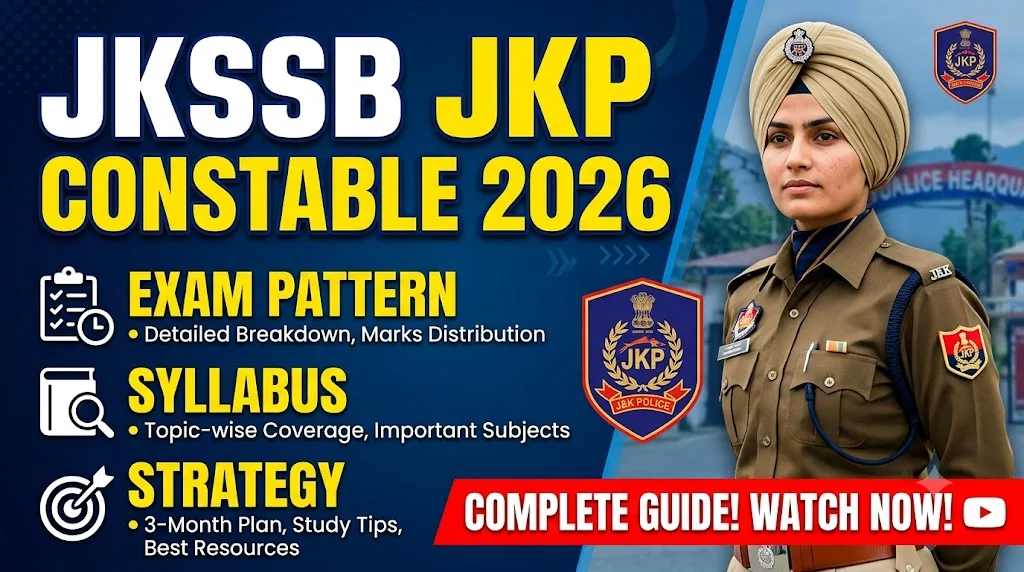
Constable recruitment is JKSSB’s largest-volume drive this cycle, and with written exam dates now confirmed across four categories running from 13 to 30 December 2026, thousands of aspirants across Jammu and Kashmir are entering their final preparation stretch. Whether you are appearing for Constable (Executive), Armed/IRP/SDRF, Telecommunication, or Photographer, the core preparation approach is similar, with some important category-specific differences worth knowing.
This guide covers the confirmed schedule, the written exam pattern, the full subject-wise syllabus, what happens in the physical stages, and a realistic plan for using the time you have left.
Confirmed Constable Exam Schedule
| Category | Exam Date | Day |
|---|---|---|
| Constable (Executive) | 13 December 2026 | Sunday |
| Constable (Armed/IRP/SDRF) | 20 December 2026 | Sunday |
| Constable (Telecommunication) | 27 December 2026 | Sunday |
| Constable (Photographer) | 30 December 2026 | Wednesday |
If you have applied for more than one category, note the different dates carefully — overlapping preparation is fine, but exam-day logistics need to be planned separately for each.
A word of caution: these dates come from JKSSB’s latest circulated notice. Confirm your specific date against the official PDF on jkssb.nic.in before finalising travel or leave plans, since JKSSB has rescheduled individual exams in this very cycle due to weather and administrative reasons.
JKP Constable Written Exam Pattern
| Detail | Specification |
|---|---|
| Total Questions | 100 |
| Total Marks | 100 |
| Duration | 2 hours (120 minutes) |
| Negative Marking | 0.25 per wrong answer |
| Mode | Offline, OMR-based, objective MCQs |
| Medium | English |
Compared to JKPSI’s steeper 0.5 penalty, Constable’s 0.25 negative marking gives you slightly more room to make educated guesses — but accuracy still matters, especially with 1,815 vacancies for Constable (Executive) alone drawing heavy competition.
Selection Process: From Written Exam to Final Merit
The JKP Constable recruitment follows a multi-stage process, and it is worth understanding upfront that final merit is based only on written exam marks — the physical rounds are qualifying, not scoring, stages. That said, failing to clear them removes you from contention entirely, so they cannot be treated as a formality.
- Written Examination — the OMR-based test on your category’s confirmed December date.
- Physical Standard Test (PST) — height, weight, and chest measurement checked against prescribed standards for your category and gender. Qualifying in nature.
- Physical Endurance Test (PET) — typically includes a long-distance race, push-ups, and shot put, varying by category. Qualifying in nature.
- Document Verification — educational, domicile, and category certificates.
- Medical Examination — final health and fitness clearance.
Because PST measurements and PET standards (race distance, timing, repetitions) vary by category, gender, and can be revised between cycles, always verify the exact figures from your official notification rather than relying on numbers from a previous recruitment year.
Subject-Wise Syllabus and Strategy
The Constable (Executive) written exam draws from five core areas, with additional technical sections layered in for the Telecommunication and Photographer categories.
1. General Knowledge & Current Affairs (India)
Covers major national and international current events, history, polity, and general static GK — important dates in Indian history, notable personalities, and international organisations like the UN. Build a habit of daily newspaper reading rather than trying to memorise GK compilations close to the exam.
2. General Knowledge with Special Reference to J&K
History, geography, culture, and administrative changes specific to Jammu & Kashmir. Questions from this section are asked frequently, making it one of the highest-return areas for focused, regional-specific preparation.
3. English Language
Basic grammar, vocabulary, and comprehension. This is considered one of the more scoring sections in the exam — daily vocabulary building and regular comprehension practice compound quickly over a few months.
4. Numerical and Reasoning Ability
Basic arithmetic (percentages, ratios, simple interest, averages) combined with logical and analytical reasoning (series, coding-decoding, analogies). Since this section blends speed and logic, timed daily practice matters more than reading theory.
5. Basic Concepts of Computers
Fundamental computer knowledge — hardware, software basics, and general digital literacy. A lighter section that rewards a few dedicated revision sessions rather than deep study.
6. Technical Subjects (Telecommunication and Photographer Categories Only)
- Telecommunication: basics of communication systems, networking fundamentals, and telecom equipment relevant to policing work.
- Photographer: camera types and formats, lighting, image composition, and basic photo processing techniques.
If you are appearing for either of these specialised categories, treat the technical section as a distinct subject requiring its own dedicated study block — it is not covered by general GK or reasoning preparation.
A Realistic Study Timetable
With roughly four to five months between now and your exam date (depending on category), here is a workable structure:
| Phase | Timeline | Focus |
|---|---|---|
| Foundation | Now – Late September | Complete first read-through of all subjects; build a J&K GK notebook |
| Strengthening | October | Subject-wise practice sets; begin technical-subject study if applicable |
| Full-Length Practice | November | Full 100-question mock tests under strict 120-minute timing |
| Physical Preparation | Ongoing throughout | Running, push-ups, and category-specific PET drills, built into your weekly routine from day one |
| Final Revision | Exam week | No new topics — only revision, light practice, and rest |
Because PST and PET remain qualifying gates even though they don’t affect your final rank, they deserve consistent attention from the start rather than being treated as an afterthought once the written result arrives.
Common Mistakes Constable Aspirants Make
- Delaying physical training until after the written exam. With qualifying PET standards to meet, waiting until the written result leaves too little runway to build real fitness.
- Treating technical subjects as optional for Telecom/Photographer posts. These sections are scored just like any other subject and cannot be skipped or crammed at the last minute.
- Overloading on national current affairs while under-preparing J&K-specific content. Given how frequently J&K questions appear, regional preparation deserves at least equal weight to national GK.
- Ignoring accuracy in favor of attempting every question. Even with a comparatively lighter 0.25 penalty, careless guessing across 100 questions can meaningfully drag down your score.
- Skipping OMR-format mock practice. Filling bubbles accurately under a 120-minute time cap is a skill that needs practice in its own right, not just subject knowledge.
Key Takeaways
- JKP Constable written exams are confirmed across four categories, running 13–30 December 2026.
- The written test has 100 questions worth 100 marks in 2 hours, with 0.25 negative marking per wrong answer.
- Final merit is based solely on written exam marks — PST and PET are qualifying stages, but failing them removes you from the process entirely.
- Telecommunication and Photographer candidates have an additional technical subject that needs dedicated preparation, separate from general GK and reasoning.
- Building physical training into your weekly routine now, rather than after the written result, is essential given the qualifying PET standards.
Conclusion
The Constable recruitment draws some of the largest applicant pools in JKSSB’s calendar, which makes disciplined, structured preparation more important than ever. With your category’s exam date now fixed somewhere between 13 and 30 December 2026, the smartest move is to treat written preparation and physical training as parallel tracks rather than sequential ones. Stay consistent with J&K-focused GK, respect the negative marking, and — if you’re appearing for a technical category — give that subject the same seriousness as everything else on the syllabus.
Frequently Asked Questions
1. What are the confirmed JKP Constable exam dates for 2026?
Constable (Executive) is scheduled for 13 December 2026, Constable (Armed/IRP/SDRF) for 20 December 2026, Constable (Telecommunication) for 27 December 2026, and Constable (Photographer) for 30 December 2026, as per JKSSB’s latest notice.
2. What is the exam pattern for JKP Constable 2026?
The written exam consists of 100 objective-type questions worth 100 marks, to be completed in 2 hours, with 0.25 marks deducted for each incorrect answer.
3. Does the PST/PET score affect final merit?
No. Final merit for Constable posts is based solely on written exam marks. PST and PET are qualifying stages — candidates must clear them to remain in the process, but performance in these rounds does not add to the merit score.
4. What extra preparation is needed for Telecommunication or Photographer Constable posts?
These categories include an additional technical subject — communication systems and networking basics for Telecommunication, and camera and photography fundamentals for Photographer — on top of the general syllabus covered by all candidates.
5. When should I start physical fitness preparation for PST/PET?
Ideally alongside your written exam preparation, not after it. Since PET and PST standards must be met regardless of your written score, starting fitness training now gives you the best chance of clearing both qualifying stages comfortably.
Official Resources
- JKSSB Official Website: https://jkssb.nic.in
- JKSSB Notices & Notifications Section: https://jkssb.nic.in/Notice.aspx
- JKSSB Admit Card Portal: https://jkssb.nic.in
- Jammu & Kashmir Police Official Website: https://jkpolice.gov.in
- Jammu & Kashmir Government Official Portal: https://jk.gov.in

Zahid Bhat is the founder of ExamzPrep. He has spent the last 4 years following JKSSB, SSC, Banking, Railway, UPSC, and State PSC recruitment cycles closely — tracking syllabus changes, question paper trends, and notification updates — and has qualified a JKSSB examination himself. ExamzPrep is built on that firsthand preparation experience: honest, free content for self-studying aspirants, with no courses to sell and no coaching to promote.