
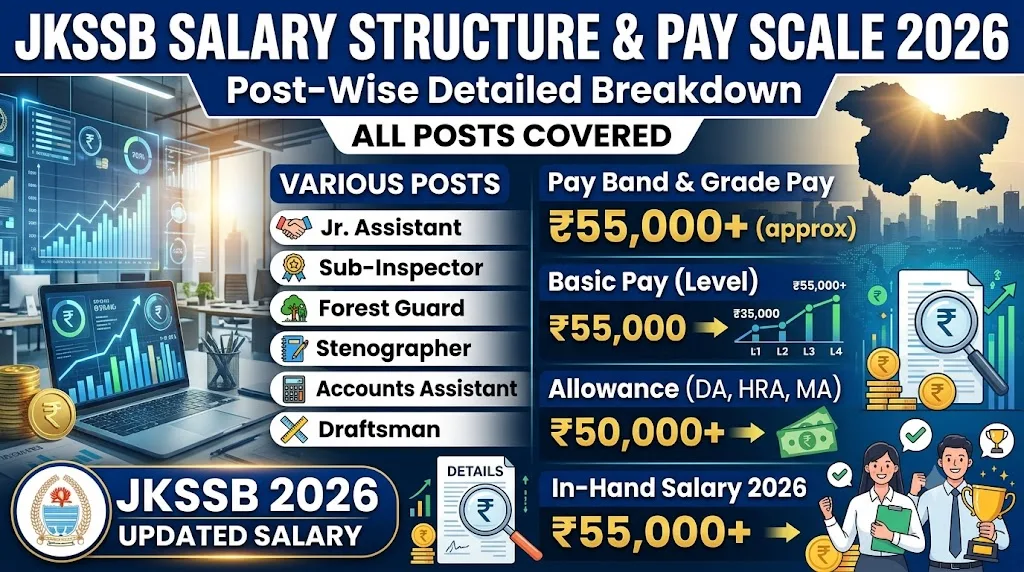
One of the first things a serious JKSSB aspirant asks is: what will my actual monthly salary look like after joining? It’s a fair question, and the answer isn’t as simple as quoting the pay scale from the notification, because the number printed in an advertisement is only the starting basic pay — not what arrives in your bank account each month.
This guide breaks down the JKSSB salary structure for 2026 across the most common posts, covering basic pay, pay levels, allowances that add to your gross, and the deductions that bring it down to your in-hand amount. It also covers how salaries grow over time and what the career progression picture looks like for different cadres.
How JKSSB Salaries Are Structured: The 7th Pay Commission Framework
JKSSB employees are compensated under the 7th Central Pay Commission (CPC) pay matrix. Every post sits at a defined pay level within this matrix, and that level determines both the starting basic pay and the ceiling it can reach through annual increments over a career.
The structure has three main layers:
- Basic Pay — the number fixed by the pay level, which grows annually through 3% increments
- Allowances — additions like Dearness Allowance (DA), House Rent Allowance (HRA), and Travel Allowance (TA) that push the gross salary higher
- Deductions — mandatory contributions to NPS and other statutory deductions that reduce gross pay down to the in-hand figure
Understanding all three layers is what gives you the real picture of monthly earnings.
Post-Wise Pay Level and Basic Pay Scale
The salary varies significantly based on the post level across JKSSB cadres. Here is the consolidated post-wise pay structure:
| Post | Pay Level | Basic Pay Scale (₹) |
|---|---|---|
| Class IV / Multi-Tasking Staff | SL-1 | ₹14,800 – ₹47,100 |
| Constable (J&K Police) | Level 2 | ₹19,900 – ₹63,200 |
| Junior Assistant | Level 4 | ₹25,500 – ₹81,100 |
| Patwari (Revenue) | Level 4 | ₹25,500 – ₹81,100 |
| Accounts Assistant / Teacher | Level 5 | ₹29,200 – ₹92,300 |
| Sub-Inspector (Police/Telecom) | Level 6 / 6C | ₹35,400 – ₹1,13,500 |
| Junior Engineer (Civil/Electrical) | Level 6 | ₹35,400 – ₹1,12,400 |
These ranges reflect the starting point to the maximum ceiling reachable through annual increments across a full career — not a salary band assigned at joining.
Allowances That Add to Gross Salary
Basic pay alone is never the full picture. JKSSB employees receive several allowances on top of basic pay, and their combined effect meaningfully raises the gross monthly figure.
Dearness Allowance (DA)
DA is periodically revised to account for inflation. It is calculated as a percentage of basic pay and revised by the central government twice a year (January and July). As of current revision cycles, DA stands at a significant percentage of basic pay, adding several thousand rupees to the gross monthly salary for most posts.
House Rent Allowance (HRA)
HRA is classified by city type — X, Y, and Z categories — with higher rates applicable to Jammu and Srinagar urban areas. For employees posted in rural or remote locations, HRA is lower, while those stationed in Srinagar or Jammu city limits receive the higher urban-classified rates.
Other Allowances
Additional perks include Travel Allowance to cover travel-related expenses during official duties, and Medical Benefits providing comprehensive healthcare facilities for employees and their families
Post-Wise In-Hand Salary Estimates
The in-hand salary — what actually lands in your account after deductions — is typically lower than the gross figure by 15–20%, depending on the post level and posting location.
Class IV / Multi-Tasking Staff
Class IV and Multi-Tasking Staff posts fall under Pay Level SL-1, with a basic pay range of ₹14,800 to ₹47,100. After adding DA, HRA, and other applicable allowances, and deducting NPS and other statutory contributions, the in-hand monthly salary for a freshly joined Class IV employee typically works out to roughly ₹18,000–₹22,000 depending on posting location.
Constable (J&K Police)
The JK Police Constable salary falls under Pay Level 2, with a pay scale in the range of ₹19,900 to ₹63,200. After allowances and deductions, the effective in-hand amount for a newly joined constable is generally in the ₹25,000–₹30,000 range, varying with posting location and applicable HRA slab
Junior Assistant
The JKSSB Junior Assistant salary is in Level-4 Pay Scale, ranging from ₹25,500 to ₹81,100. Candidates appointed under Pay Level 5 receive a basic pay of ₹29,200 along with Dearness Allowance (DA), House Rent Allowance (HRA), and other admissible benefits as per UT government rules. For Level 4 Junior Assistants, the estimated gross monthly salary including allowances sits around ₹40,000–₹45,000, with in-hand pay typically landing in the ₹33,000–₹38,000 range after standard deductions.
Patwari (Revenue Department)
The JKSSB Patwari falls under Pay Level 4 with a basic salary of ₹25,500, with a pay scale up to ₹81,100. Including DA, HRA, and other allowances, the gross salary is around ₹45,600 per month. After deductions, the in-hand pay is approximately ₹36,900 per month.
Sub-Inspector (Police / Telecom)
The JKSSB Sub-Inspector (Telecommunication) pay scale falls under Level 6C at ₹35,700 to ₹1,13,100. For Sub-Inspector posts more broadly, the Level-6 pay scale runs from ₹35,400 to ₹1,13,500. A freshly joined Sub-Inspector can expect a gross monthly salary in the ₹55,000–₹65,000 range, with in-hand pay after NPS and other deductions typically landing around ₹47,000–₹55,000 depending on posting location.
Junior Engineer (Civil / Electrical)
The JKSSB Junior Engineer salary falls under Level 6 with a basic pay scale ranging from ₹35,400 to ₹1,12,400. With DA, HRA, and other applicable allowances added, a new JE’s gross monthly package typically lands between ₹55,000 and ₹65,000. In-hand figures after NPS and statutory deductions are generally in the ₹46,000–₹54,000 range.
Salary Comparison Table: Post-Wise Overview
| Post | Pay Level | Starting Basic Pay | Approx. Gross/Month | Approx. In-Hand/Month |
|---|---|---|---|---|
| Class IV / MTS | SL-1 | ₹14,800 | ₹22,000–₹25,000 | ₹18,000–₹22,000 |
| Constable (Police) | Level 2 | ₹19,900 | ₹30,000–₹35,000 | ₹25,000–₹30,000 |
| Patwari | Level 4 | ₹25,500 | ~₹45,600 | ~₹36,900 |
| Junior Assistant | Level 4 | ₹25,500 | ₹40,000–₹45,000 | ₹33,000–₹38,000 |
| Accounts Assistant / Teacher | Level 5 | ₹29,200 | ₹47,000–₹52,000 | ₹39,000–₹44,000 |
| Sub-Inspector | Level 6 / 6C | ₹35,400–₹35,700 | ₹55,000–₹65,000 | ₹47,000–₹55,000 |
| Junior Engineer | Level 6 | ₹35,400 | ₹55,000–₹65,000 | ₹46,000–₹54,000 |
Note: Gross and in-hand figures are estimates based on current DA rates and standard HRA slabs. Actual figures vary with posting location, DA revision cycle, and applicable tax slab. Always verify exact amounts from the official appointment order or notification.
Deductions Explained
The gap between gross salary and in-hand pay comes from a few standard deductions applied to every government employee:
- National Pension Scheme (NPS): A 10% deduction from basic pay goes toward the employee’s NPS account, with the government also contributing its share separately
- Provident Fund (PF): A standard 12% of basic pay contribution applies to applicable cadres
- Income Tax (TDS): Deducted at source where salary crosses the taxable threshold — not applicable to Class IV and lower-level posts at starting pay
- Insurance/Other: A nominal monthly deduction (around ₹100) for group insurance cover
For a Patwari, for example, deductions include PF of ₹3,621, NPS of ₹3,060, and applicable taxes. Similar proportions apply across other posts at their respective pay levels
Annual Increment and Salary Growth
Every JKSSB employee receives an annual increment of 3% of basic pay on July 1 each year, as per 7th CPC rules. Over time, this compounds meaningfully. A Junior Assistant starting at ₹25,500 basic pay reaches significantly higher basic pay after 10 years of service, before even accounting for promotions.
Promotions further accelerate salary growth:
- After serving as a Junior Engineer, employees can be promoted to the position of Assistant Engineer, with candidates also able to appear for departmental exams to qualify for further promotions.
- Junior Assistants can advance to Senior Assistant and subsequently to Section Officer roles through departmental examinations
- Constables can progress to Head Constable and then Sub-Inspector through departmental channels
Job Benefits Beyond Monthly Salary
JKSSB posts come with a package of non-monetary benefits that add significant long-term value, particularly when compared to private sector employment in the region:
- Job security — government posts in J&K carry strong tenure protection
- Medical benefits — comprehensive healthcare and medical facilities for employees and their families
- Retirement benefits — financial security post-retirement through pension schemes and other retirement-related benefits
- Leave entitlements — earned leave, casual leave, and medical leave as per UT government service rules
- Skill development — access to workshops and training programs designed to enhance skills and expertise
Key Takeaways
- JKSSB salaries follow the 7th Pay Commission matrix, ranging from Level SL-1 (Class IV) to Level 6 (Sub-Inspector, Junior Engineer)
- Basic pay is only the starting point — DA, HRA, and other allowances raise the gross salary considerably above it
- Patwari and Junior Assistant posts start at Level 4 (₹25,500), while Sub-Inspector and Junior Engineer posts offer the higher Level 6 (₹35,400) starting pay
- Mandatory deductions — primarily NPS at 10% of basic pay and PF at 12% — typically reduce gross salary by 15–20% to give the in-hand figure
- Annual 3% increments and departmental promotion channels provide steady salary growth throughout a JKSSB career
- In-hand salary estimates vary based on posting location, DA revision cycle, and the applicable HRA city classification
Conclusion
JKSSB posts offer stable, structured compensation under the 7th Pay Commission, with salaries that compare well to private sector opportunities available in Jammu and Kashmir for the same qualification levels. For aspirants deciding between posts, the salary gap between a Junior Assistant (Level 4) and a Sub-Inspector or Junior Engineer (Level 6) is meaningful — roughly ₹10,000–₹15,000 more per month in gross salary at the starting stage. That said, factors like career growth pace, nature of work, and physical requirements also influence which post is the better long-term fit.
Always cross-verify exact salary components from the official advertisement notification for your specific post, since DA rates and HRA slabs can shift between recruitment cycles.
Frequently Asked Questions
1. Is the JKSSB salary decided by the state or central government?
JKSSB follows the 7th Central Pay Commission structure, adopted by the Jammu and Kashmir UT government after reorganisation in 2019. DA revisions also follow central government schedules.
2. Is there a pension for JKSSB employees?
JKSSB recruits appointed after 2004 fall under the National Pension Scheme (NPS), not the old defined-benefit pension. NPS contributions are deducted monthly from salary, with the government also contributing its share.
3. Does posting location affect in-hand salary?
Yes. HRA is calculated based on the classification of the posting location — Srinagar and Jammu city areas attract higher HRA rates than rural or remote postings.
4. When does the first salary increment happen?
Annual increments are credited on July 1 each year, as per 7th Pay Commission rules, regardless of the month of joining.
5. Is the 8th Pay Commission expected to affect JKSSB salaries?
The 8th Pay Commission is expected to revise central government and UT salary structures. Once implemented, it will affect all JKSSB pay levels. Candidates should monitor official J&K government notifications for updates on timeline and revised pay matrices.
Official Resources
- JKSSB Official Website — jkssb.nic.in
- Jammu and Kashmir Government Official Portal — jk.gov.in
- 7th Pay Commission Pay Matrix (Government of India) — finmin.nic.in
- Department of Personnel & Training, GoI — dopt.gov.in

Zahid Bhat is the founder of ExamzPrep. He has spent the last 4 years following JKSSB, SSC, Banking, Railway, UPSC, and State PSC recruitment cycles closely — tracking syllabus changes, question paper trends, and notification updates — and has qualified a JKSSB examination himself. ExamzPrep is built on that firsthand preparation experience: honest, free content for self-studying aspirants, with no courses to sell and no coaching to promote.