
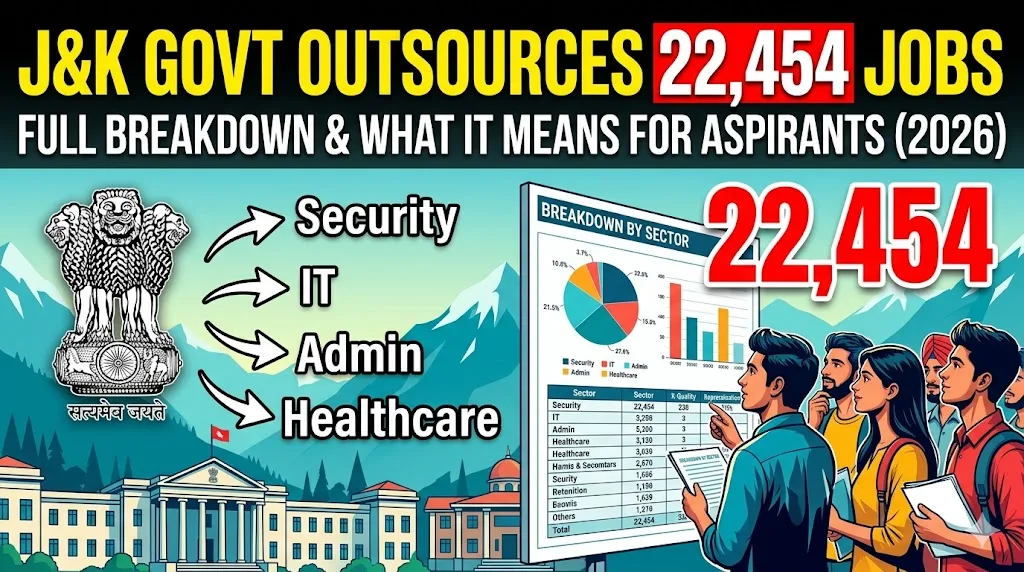
Jammu and Kashmir’s job market is once again at the centre of a heated debate. Fresh data has revealed that the Union Territory administration has outsourced 22,454 jobs across 29 government departments to more than 200 private companies over the last two years. The revelation has triggered sharp reactions from opposition parties, even as the government insists the move is not a “backdoor” route into government service but a practical solution to staffing gaps in essential services.
For lakhs of young aspirants preparing for JKSSB, JKPSC, and other competitive exams in Jammu and Kashmir, this news raises an important question: what does large-scale outsourcing mean for the future of regular, merit-based government recruitment in the UT? This article breaks down the numbers, explains how the outsourcing model actually works, and tells you exactly what it means for your exam preparation and career planning.
What Exactly Has Happened
According to information that surfaced this month, 29 different government departments in Jammu and Kashmir have together outsourced 22,454 posts to private companies over the past two years. These are not one-off appointments — they cover a wide spread of roles, including security guards, housekeeping staff, IT support and computer operators, vocational trainers and coordinators, watch and ward personnel, drivers, plumbers, financial experts, and field staff for horticulture projects such as the Tulip Garden development in Ramban district.
The companies handling this manpower are spread across Gujarat, Noida, Haryana, Punjab, Maharashtra, Madhya Pradesh and Delhi, though a significant share of them are based within Jammu and Kashmir itself. Departments are reportedly spending close to Rs 200 crore every year on these outsourcing contracts.
How the Outsourcing Process Actually Works
Unlike regular recruitment, where vacancies are notified by bodies such as the Jammu and Kashmir Services Selection Board (JKSSB) or the Public Service Commission (JKPSC), outsourced positions follow a completely different route — the Government e-Marketplace (GeM) portal.
Here’s the typical process:
- A government department identifies a manpower requirement — for example, security or sanitation staff at a hospital.
- The department floats a tender on the GeM portal.
- Private companies bid for the contract, and the lowest bidder usually wins.
- The winning company then hires and deploys its own staff to work inside the government office, hospital, or institution.
- The department pays the company for the service, and the company in turn pays salaries to the workers after deducting its service charges.
In several hospitals, for instance, payments for outsourced security and sanitation staff are made from the Hospital Development Fund, which is generated through patient ticket collections rather than the regular state budget. Contracts are typically issued for one year and can be extended for three years or more depending on the terms of the bid.
This means outsourced employees are technically employees of the private contracting company, not of the Jammu and Kashmir government — a distinction that matters a great deal when it comes to job security, pay scale, and pension benefits.
Department-Wise Breakdown of Outsourced Jobs
Here is how the 22,454 outsourced positions are reportedly distributed:
| Department | Outsourced Jobs | Purpose |
|---|---|---|
| Government Medical Colleges (Srinagar & Jammu) and Directorate of Health Services | 6,518 | Security and sanitation staff |
| Floriculture Department | 3,530 | Tulip Garden (Ramban) and Chrysanthemum Garden (Chashma Shahi) development |
| Housing & Urban Development Department | 2,005 | Civic and municipal support staff |
| Agriculture Department | 1,126 | Field and technical support staff |
| Social Welfare Department | 1,198 | Mission Vatsalya, District Social Welfare Office Jammu, and Mission Shakti |
| Transport Department (RTC) | 888 | Drivers and conductors for state transport buses |
| Other departments (combined) | Remaining posts | Various administrative, IT, and vocational roles |
The healthcare sector alone accounts for nearly 29 percent of all outsourced positions, reflecting the scale of staffing requirements in J&K’s hospitals and medical colleges.
The Political Debate: Outsourcing vs “Backdoor” Recruitment
This data has reignited a long-running political argument in Jammu and Kashmir. Opposition leaders have accused the ruling dispensation of using outsourcing as a way to bypass the transparent, merit-based selection process conducted by bodies like the JKSSB. Some legislators have gone as far as calling it an economic and social setback for the region’s youth, while others have warned that it could fuel resentment among unemployed graduates who feel shut out of a fair recruitment process.
The government, on the other hand, maintains a clear distinction between outsourcing and backdoor appointments. Officials argue that outsourcing is used specifically to meet scheme-based or service-related staffing needs — such as running hospital sanitation services or maintaining transport fleets — rather than replacing the regular cadre of permanent government posts that are filled through JKSSB or JKPSC. Supporters of the policy also point out that successive administrations, including the earlier Lieutenant Governor-led setup, relied on similar outsourcing arrangements, particularly for the Road Transport Corporation’s drivers and conductors since 2021.
Whichever side of the debate you lean towards, one fact remains unchanged for aspirants: outsourced positions and permanent JKSSB/JKPSC posts are governed by entirely different rules, and understanding that difference is essential.
Outsourced Jobs vs Permanent Government Jobs: Key Differences
| Factor | Outsourced Jobs | Regular Government Jobs (via JKSSB/JKPSC) |
|---|---|---|
| Employer | Private contracting company | Jammu & Kashmir Government |
| Selection Process | Company-level hiring, often without public notification | Public exam/interview through JKSSB, JKPSC |
| Job Security | Contract-based, renewable, no permanence | Permanent, pensionable service |
| Pay Scale | Fixed monthly wage set by company contract | Government pay scale with allowances, DA, and increments |
| Career Growth | Limited promotion avenues | Structured promotions and seniority benefits |
| Pension & Retirement Benefits | Generally not applicable | Available under applicable pension/NPS rules |
This is precisely why exam aspirants should not confuse outsourcing news with a reduction in regular recruitment opportunities. The JKSSB and JKPSC recruitment calendar continues independently, and outsourced postings are not a substitute for the permanent vacancies notified through these boards.
What This Means for JKSSB and JKPSC Aspirants
If you’re preparing for JKSSB, JKPSC, JKBOSE, or other J&K government exams, here’s the practical takeaway:
- Outsourcing does not replace JKSSB recruitment. The posts being outsourced are largely support-staff and service-based roles, distinct from the gazetted and non-gazetted cadre posts that JKSSB and JKPSC notify through their regular advertisements.
- Class IV recruitment rules are also under review. Separately, the J&K government has constituted a high-level committee to revisit the rules governing Class IV (Multi-Tasking Staff) appointments, with thousands of MTS, gazetted, and non-gazetted posts currently lying vacant. This signals that structured recruitment drives for these categories may be reformed and reopened in the coming months — something aspirants should track closely.
- Stay alert to official notifications only. With outsourcing contracts often arranged quietly through the GeM portal, the only reliable way to track genuine recruitment opportunities remains the official JKSSB, JKPSC, and respective department websites.
- Continue your preparation without distraction. Outsourcing trends, while politically significant, do not change the syllabus, exam pattern, or eligibility criteria for competitive exams. Aspirants should treat this as background context rather than a reason to delay or alter their preparation strategy.
Should You Consider Applying for Outsourced Positions?
For candidates looking for short-term income or practical work experience while preparing for competitive exams, outsourced roles in sectors like healthcare support, IT operations, or transport can offer temporary employment. However, given the lack of long-term job security, absence of pension benefits, and limited scope for promotion, these positions are best viewed as interim opportunities rather than a substitute for a permanent government career. Aspirants serious about long-term stability should continue focusing on JKSSB and JKPSC recruitment cycles, where merit-based selection still leads to pensionable, permanent employment.
Frequently Asked Questions
Q1. How many jobs has the J&K government outsourced so far? As per recent disclosures, 29 government departments in Jammu and Kashmir have outsourced 22,454 jobs to over 200 private companies during the last two years.
Q2. Which department has outsourced the most jobs? The Government Medical Colleges of Srinagar and Jammu, along with the Directorate of Health Services, account for the highest number of outsourced positions at 6,518, mainly for security and sanitation work.
Q3. Is outsourcing the same as backdoor recruitment? No. Outsourcing involves hiring through private companies via the GeM portal for specific service contracts, whereas backdoor recruitment refers to bypassing the official, merit-based selection process for permanent government posts. The government maintains these are legally and procedurally different, though opposition parties dispute this characterisation.
Q4. Will outsourcing affect JKSSB or JKPSC recruitment? Outsourced posts are largely service and support roles and are separate from the permanent cadre positions notified by JKSSB and JKPSC. Aspirants should continue tracking official board notifications for genuine recruitment opportunities.
Q5. How can I apply for an outsourced job in J&K? Outsourced hiring is typically managed by private companies that win government tenders through the GeM portal. There is no centralised public application process, so opportunities are usually advertised by the contracting companies directly rather than through JKSSB-style notifications.
Q6. Are outsourced employees eligible for government pension benefits? No. Outsourced employees are hired by private companies, not the government, and are generally not covered under government pension or retirement benefit schemes.
Conclusion
The outsourcing of 22,454 jobs across Jammu and Kashmir’s government departments highlights the administration’s reliance on private manpower contracts to plug staffing gaps in healthcare, transport, horticulture, and welfare schemes. While the political debate over “outsourcing versus backdoor recruitment” continues to play out, the more important takeaway for job aspirants is clear: regular, merit-based recruitment through JKSSB and JKPSC remains a separate track, and staying updated through official channels is the safest way to plan your government job preparation in 2026 and beyond.
Stay connected with us for the latest updates on JKSSB recruitment, JKPSC notifications, and government job news from across Jammu and Kashmir.

Zahid Bhat is the founder of ExamzPrep. He has spent the last 4 years following JKSSB, SSC, Banking, Railway, UPSC, and State PSC recruitment cycles closely — tracking syllabus changes, question paper trends, and notification updates — and has qualified a JKSSB examination himself. ExamzPrep is built on that firsthand preparation experience: honest, free content for self-studying aspirants, with no courses to sell and no coaching to promote.