
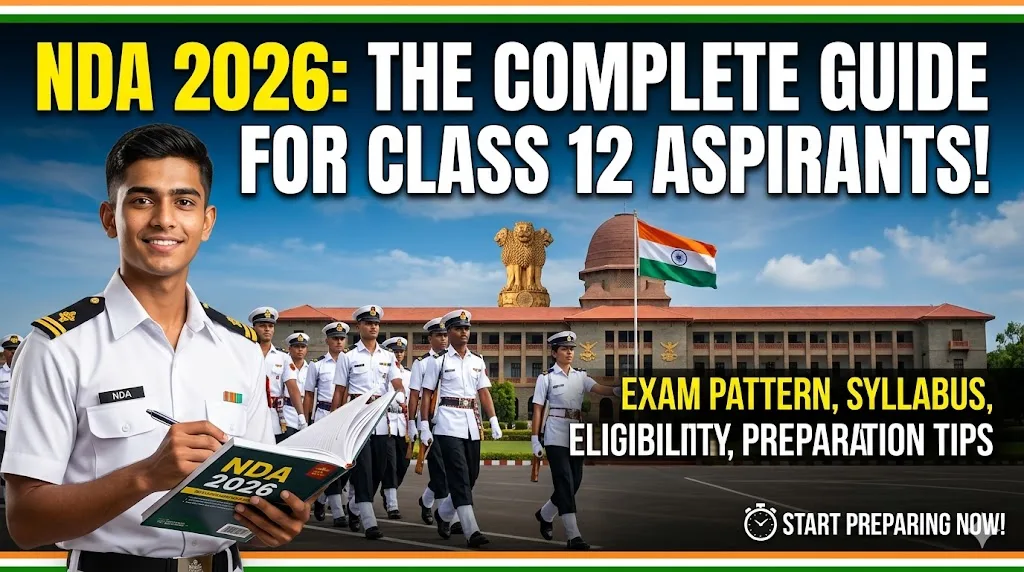
The National Defence Academy examination conducted by UPSC is the gateway to a career as an officer in the Indian Army, Navy, or Air Force. It is the only UPSC examination that does not require graduation — candidates appear after Class 12 (or even while in Class 12) and join the NDA for 3 years of training before commissioning as officers.
NDA is one of the most prestigious career paths in India — it produces the core leadership of India’s armed forces, and NDA alumni have gone on to become chiefs of the Army, Navy, and Air Force.
NDA 2026 — Overview
| Detail | Information |
|---|---|
| Conducting Body | Union Public Service Commission (UPSC) |
| Academy | National Defence Academy, Khadakwasla, Pune |
| Services | Indian Army, Indian Navy, Indian Air Force |
| Qualification | Class 12 pass (or appearing) |
| Age Limit | 16.5–19.5 years |
| Gender | Open to male and female candidates (female eligibility expanded in 2022) |
| Exam | Twice per year (NDA I and NDA II) |
| Official Website | upsc.gov.in |
NDA Training and Career Path
Unlike all other exams covered on this site, NDA is not a job — it is entry into a 3-year residential training academy followed by commissioning as a permanent officer in the armed forces.
At NDA (3 years): Cadets complete a joint services training including academics (B.Sc. or B.Tech from JNU, Delhi), physical training, military training, and service-specific training.
After NDA (service-specific training): Army cadets go to IMA (Indian Military Academy), Dehradun; Navy cadets to Naval Academy, Ezhimala; Air Force cadets to Air Force Academy, Dundigal. This takes another 1–1.5 years.
Officer commissioning: After completing all training, candidates are commissioned as permanent commissioned officers — Second Lieutenant (Army), Sub-Lieutenant (Navy), Flying Officer (Air Force).
Starting salary as officer: ₹56,100 basic pay (Level 10) plus military service pay, allowances, free accommodation, and rations — total compensation significantly higher than civilian government jobs at the same age.
NDA 2026 Exam Pattern
The NDA written examination has two papers:
Paper 1 — Mathematics
| Detail | Information |
|---|---|
| Marks | 300 |
| Questions | 120 |
| Duration | 2.5 hours |
| Level | Class 11–12 Mathematics |
| Negative Marking | 0.83 marks per wrong answer |
Paper 2 — General Ability Test (GAT)
| Section | Marks |
|---|---|
| Part A — English | 200 |
| Part B — General Knowledge | 400 |
| Total | 600 |
Duration: 2.5 hours
- Negative marking: 1.33 marks per wrong answer in GAT
- Total written exam: 900 marks
SSB (Service Selection Board) Interview
- 900 marks
- 5-day residential assessment at SSB centres
- Tests Officer Like Qualities (OLQs) — personality, leadership, intelligence, psychological fitness
Final Merit: Written exam (900) + SSB (900) = 1800 marks total
Complete Syllabus
Mathematics (300 marks)
- Algebra — sets, quadratic equations, complex numbers, logarithms, binomial theorem, permutation and combination
- Matrices and determinants — types, operations, solutions of linear equations
- Trigonometry — functions, identities, inverse trigonometric functions, heights and distances
- Analytical geometry — 2D (lines, circles, parabola, ellipse, hyperbola) and 3D (points, lines, planes)
- Differential calculus — limits, continuity, derivatives, applications
- Integral calculus — indefinite and definite integrals, areas under curves, differential equations
- Vector algebra — vectors, dot product, cross product, applications
- Statistics and probability — frequency distributions, measures of central tendency, probability theorems
Level: Class 11–12 NCERT Mathematics is the foundation. NDA Maths is harder than Board exams but manageable with Class 11–12 thorough preparation.
English (200 marks)
- Reading comprehension passages
- Fill in the blanks
- Synonyms and antonyms
- Spotting errors
- Sentence improvement
- Para jumbles
- Idioms and phrases
- One-word substitution
- Ordering of words
General Knowledge (400 marks)
Physics (Class 10–12 level):
- Physical properties of matter, mass, weight, volume
- Motion, velocity, acceleration, Newton’s laws
- Work, energy, power
- Sound and light — properties, reflection, refraction
- Electricity and magnetism
- Atomic structure basics
- Nuclear physics basics — fission, fusion, radioactivity
Chemistry (Class 10–12 level):
- Physical and chemical changes
- Elements, mixtures, compounds
- Acids, bases, salts
- Oxidation and reduction
- Carbon and its compounds
- Fertilisers — natural and artificial
- Materials used in defence — explosives, propellants basics
General Science:
- Living and non-living things
- Cell — structure and function
- Plant and animal nutrition
- Human physiology — blood circulation, respiration, digestion, nervous system
- Common diseases — causes, prevention
History (Indian and World):
- Freedom struggle — major events, personalities, movements
- Indian history from ancient to modern periods
- World history — French Revolution, industrial revolution, world wars, Russian Revolution, UN formation
Geography:
- Earth’s structure
- Atmosphere — weather, climate, ocean currents
- Physical geography — mountain ranges, rivers, seas
- India-specific geography — states, rivers, climate, agriculture
Current Events:
- Current events of national and international importance
- Who’s in the news — political leaders, scientists, sports figures
- Recent developments in science and technology
- Books and authors, awards
- Defence-specific current affairs — new weapons, exercises, appointments
The SSB — What It Tests
The SSB (Service Selection Board) is unlike any other stage in government recruitment. It is a 5-day residential assessment that evaluates whether you have the personality qualities required to be a military officer.
Day 1 — Screening: Officers Intelligence Rating (OIR) test + Picture Perception and Discussion Test (PPDT). Candidates not meeting minimum standards are sent home on Day 1.
Days 2–4 — Testing: Multiple tests assessing Officer Like Qualities:
- Psychological tests — Thematic Apperception Test, Word Association Test, Situation Reaction Test, Self Description Test
- Group tests — Group Discussion, Group Planning Exercise, Progressive Group Task, Half Group Task, Command Task, Final Group Task, Individual Obstacles
- Interview — Personal interview by an Interviewing Officer
Day 5 — Conference: Final conference with the complete SSB board. Recommendation or non-recommendation is communicated.
What the SSB looks for:
- Leadership — can you influence and motivate others?
- Initiative — do you take charge in ambiguous situations?
- Effective intelligence — can you apply thinking practically?
- Determination — do you persist under pressure?
- Communication — can you express yourself clearly?
- Responsibility — do you take ownership of outcomes?
- Cooperation — can you work effectively in a team?
The SSB cannot be crammed. It assesses genuine personality qualities developed over years. However, understanding the process, practicing group tasks, and working on communication and leadership in everyday life significantly improves SSB performance.
Eligibility
Qualification: Class 12 pass (or appearing) in any stream.
For Army: Any stream acceptable.
For Navy: Physics and Mathematics mandatory in Class 12.
For Air Force: Physics and Mathematics mandatory in Class 12.
Age: Must be between 16.5 and 19.5 years as on the date specified in the notification.
Physical standards: Candidates must meet specific height, weight, and medical standards for each service. Vision standards are particularly important — colour blindness disqualifies for Air Force; vision requirements vary by service.
Preparation Strategy
Mathematics — Build Class 11–12 Foundation
NDA Mathematics requires Class 11–12 level preparation — particularly strong in Calculus, Trigonometry, and Coordinate Geometry. R.D. Sharma or R.S. Aggarwal for these topics, alongside NCERTs for conceptual foundation.
Practice speed — 120 questions in 2.5 hours means approximately 75 seconds per question. Many NDA Maths questions require calculations — practice without calculator.
English — SSC-Level Preparation Works
The English section is similar to SSC-level English — same question types, similar difficulty. Standard English preparation resources (SP Bakshi, Wren & Martin for grammar) are sufficient.
General Knowledge — NCERT-Based
NCERTs for Physics (11–12), Chemistry (11–12), and History are the primary sources. Supplement with Lucent GK for static content and monthly current affairs for recent events.
Defence-specific GK: Know India’s defence — recent weapon inductions (Tejas, Arjun MK2, INS Vikrant, Rafale), major military exercises, recent defence agreements, and Chiefs of the three services. These appear regularly in NDA GK.
Official Link
UPSC Official Website: upsc.gov.in
NDA notifications are published twice annually — typically January (NDA I) and May/June (NDA II).
Published by ExamzPrep — free government exam preparation for serious aspirants. Last updated June 2026.

Zahid Bhat is the founder of ExamzPrep. He has spent the last 4 years following JKSSB, SSC, Banking, Railway, UPSC, and State PSC recruitment cycles closely — tracking syllabus changes, question paper trends, and notification updates — and has qualified a JKSSB examination himself. ExamzPrep is built on that firsthand preparation experience: honest, free content for self-studying aspirants, with no courses to sell and no coaching to promote.