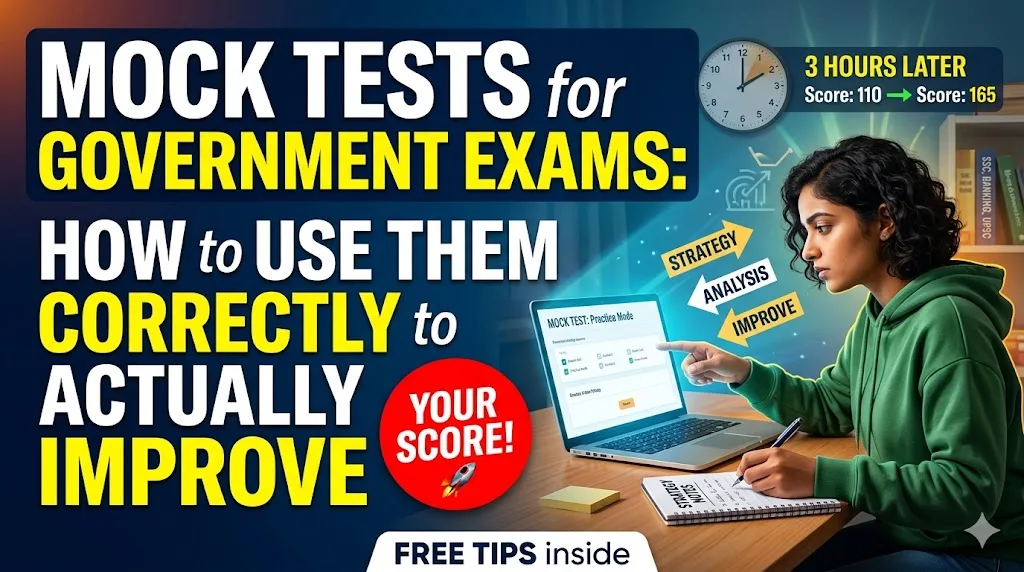
Most aspirants use mock tests wrong. They take a test, check the score, feel good or bad about it, and move on. This approach makes mock tests feel productive while delivering almost no actual improvement.
Mock tests are the most powerful tool in government exam preparation — but only when used as diagnostic and learning tools rather than performance checks. This guide shows you exactly how to use them to improve your actual exam score.
Why Mock Tests Are Not Being Used Correctly
The standard approach:
- Take a mock test (2 hours)
- Check the score
- Feel motivated if the score is high, demotivated if it is low
- Repeat next week
The problem: The score tells you nothing useful on its own. What tells you something useful is understanding exactly which questions you got wrong, why you got them wrong, and what that means for your preparation.
A candidate who takes 20 mock tests and checks only scores is doing 20 hours of preparation with 2 hours of learning. A candidate who takes 10 mock tests and spends 8 hours analysing each one is doing 10 hours of preparation with 80 hours of learning.
When to Start Taking Mock Tests
Do not start mock tests before covering 60–70% of the syllabus.
Mock tests before adequate syllabus coverage:
- Produce low scores that are discouraging without being informative
- Reinforce wrong answers as patterns (your brain adapts to whatever you practice)
- Waste time that would be better spent on foundational preparation
Start mock tests when:
- You have covered the major topics in each subject
- You can attempt at least 50–60% of questions (even if accuracy is low)
- You are in Phase 2 or Phase 3 of preparation (not Phase 1)
Types of Mock Tests — Use Each for Different Purposes
Full-Length Mock Tests
A complete exam simulation — same number of questions, same time limit, same subject division as the actual exam.
Use for:
- Building time management skills
- Identifying which sections you run out of time on
- Practising exam-day sequencing and decision making
- Measuring overall performance trajectory over time
Frequency: 1 per week during Phase 2, 2–3 per week in Phase 3 (final month)
Sectional Tests
Tests covering only one subject — only Reasoning, or only Maths, or only English.
Use for:
- Intensive practice on a specific weak subject
- Building speed on a specific section
- Accuracy improvement before adding time pressure
Frequency: 2–3 per week in Phase 2 for weak subjects
Topic-wise Tests
Tests covering only one topic within a subject — only Puzzles in Reasoning, or only Percentages in Maths.
Use for:
- Drilling a specific topic after identifying weakness in sectional or full-length tests
- Building mastery on a specific question type
- Accuracy improvement before moving to sectional tests
Frequency: As needed, based on analysis from higher-level tests
The Analysis Framework — What to Do After Every Mock Test
This is the most important section of this guide. The analysis after a mock test is where the learning happens.
Step 1 — Score and Section-wise Breakdown (5 minutes)
Calculate total score and score per section. Record this in a tracking sheet (see below). Look for trends over multiple tests — are scores improving, stagnating, or declining in each section?
Step 2 — Category Analysis (20 minutes)
Go through every wrong answer. For each wrong answer, categorise it into one of four types:
Type A — Knowledge Gap: You did not know the answer because you have not studied the topic. The correct answer was not one you could have worked toward.
Type B — Silly Mistake: You knew the answer but made a careless error — miscalculated, misread the question, darkened the wrong option, or made an arithmetic error you would catch on review.
Type C — Time Pressure: You knew the approach but ran out of time before completing the calculation or reasoning. You guessed at the end.
Type D — Negative Marking Mistake: You attempted a question you should have skipped and got it wrong.
Count how many wrong answers fall into each category.
Step 3 — Topic-level Analysis (15 minutes)
For Type A errors (knowledge gaps), list the specific topic of each wrong answer. Look for patterns — are multiple Type A errors from the same topic?
This gives you your priority list for additional study before the next mock test.
Step 4 — Time Analysis (10 minutes)
Review your time allocation across sections. For full-length tests:
- Which section did you spend the most time on?
- Did you run out of time in any section?
- Which questions took more than 90 seconds? Were they worth that time investment?
Time management problems are separate from knowledge problems and require separate fixes — more timed practice, not more content study.
Step 5 — Action Items (5 minutes)
Based on the analysis, set specific preparation targets before your next mock test:
- 2–3 topics to study (from Type A analysis)
- 1 skill to practice (time management, calculation speed, or a specific question type)
The Mock Test Tracking Sheet
Maintain a simple tracking sheet across all your mock tests:
| Mock # | Date | Total Score | Reasoning | Maths | English | GK | Remarks |
|---|---|---|---|---|---|---|---|
| 1 | May 1 | 112/200 | 28/50 | 22/50 | 35/50 | 27/50 | Weak in Maths DI |
| 2 | May 8 | 118/200 | 30/50 | 25/50 | 34/50 | 29/50 | Maths improved, GK static |
Also track:
- Number of Type A, B, C, D errors per test
- Accuracy % per section (not just marks — accuracy = correct / attempted)
- Topics of Type A errors (knowledge gaps)
After 5+ mocks, patterns emerge that are invisible from individual test results. This data tells you exactly where to focus preparation.
Fixing Each Error Type
Fixing Type A Errors (Knowledge Gaps)
Return to your study material on the specific topic. Read it again — more carefully this time, with the context of knowing you got exam questions on this topic wrong. Then solve 30–50 practice questions specifically on that topic. Then return to a sectional or full-length mock and check whether accuracy on that topic has improved.
Fixing Type B Errors (Silly Mistakes)
Silly mistakes are habits, not knowledge problems. They require habit-level fixes:
- Build a personal “silly mistake list” — write down every Type B error with what specifically went wrong
- Before starting any practice session, review the last 3–5 items on your list
- For calculations: write working step by step rather than doing it in your head
- For question reading: underline key words before answering
Fixing Type C Errors (Time Pressure)
Time pressure errors require timed practice, not content study. Two approaches:
- Drill the question type: Solve 20 questions of the same type under time pressure (e.g. 20 puzzle questions in 25 minutes). Speed comes from recognising patterns faster.
- Adjust your sequence: If you consistently run out of time on Maths, change your exam sequence — attempt Maths earlier when you have full time, not at the end.
Fixing Type D Errors (Negative Marking Mistakes)
Review your negative marking strategy. If you are consistently losing marks from incorrect attempts on uncertain questions, raise your threshold for attempting. Commit to a specific rule: “I only attempt if I can eliminate at least one option.”
Selecting Mock Test Sources
Not all mock tests are created equal. Poor-quality mocks with wrong answers, incorrect difficulty calibration, or outdated content will mislead your preparation.
For SSC exams:
- Official SSC previous year papers (the gold standard — always accurate)
- Testbook, Oliveboard, Adda247 mock series (reliable, updated regularly)
For Banking exams (IBPS, SBI):
- Official previous year papers from ibps.in and sbi.co.in
- Oliveboard, Adda247, Testbook (banking-specific)
For Railway exams:
- Official previous year papers from indianrailways.gov.in / RRB websites
- Arihant RRB series, Kiran Publications previous papers
For UPSC and State PSC:
- Official previous year papers (mandatory — the only truly representative source)
- InsightsIAS, Vision IAS, Forum IAS for UPSC-level mocks
Warning signs of poor-quality mocks:
- Questions with contested or unclear correct answers
- Difficulty level inconsistent with the actual exam
- Questions from outdated syllabus or pattern
- Solutions that are incorrect or poorly explained
When in doubt, prioritise official previous year papers over any commercial mock series.
Mock Test Schedule — By Preparation Phase
Phase 1 (Foundation — months 1–3)
No full-length mocks. Use only topic-wise tests after completing each topic.
Phase 2 (Practice — months 3–5)
- 1 sectional test per weak subject per week
- 1 full-length mock per week (starting from the end of month 3)
- Full analysis after every mock
- Topic-wise drilling based on analysis
Phase 3 (Final — months 5–6)
- 2–3 full-length mocks per week
- Full analysis after every mock
- Targeted revision of remaining weak areas
- Stop new content — only revision and mock analysis
Final 2 weeks
- 1 mock per week maximum
- Focus entirely on revision and consolidation
- Do not take mocks in the final 3 days — rest and mental preparation
The Right Mindset for Mock Tests
A mock test score in preparation is not your exam score. It is a diagnostic tool.
A low mock score means your preparation has gaps — which is information, not failure. It tells you exactly where to focus. A high mock score before adequate preparation means your mock is too easy or you are overestimating your readiness.
The only score that matters is the one on exam day. Everything before that is preparation data.
Approach every mock test with one question: “What will this test teach me about my preparation?” Not “What score will I get?” That mindset shift changes how you use mocks — from performance events to learning tools.
Published by ExamzPrep — free government exam preparation for serious aspirants. Last updated June 2026.

Zahid Bhat is the founder of ExamzPrep. He has spent the last 4 years following JKSSB, SSC, Banking, Railway, UPSC, and State PSC recruitment cycles closely — tracking syllabus changes, question paper trends, and notification updates — and has qualified a JKSSB examination himself. ExamzPrep is built on that firsthand preparation experience: honest, free content for self-studying aspirants, with no courses to sell and no coaching to promote.